
Euro Disco Radio: Europe’s Synth-Driven Dance Revolution
Late-night FM radio. Analog synthesizers glowing in dark studios. Drum machines driving hypnotic rhythms while emotional voices floated over electronic melodies. Euro Disco was more than a genre - it became a European movement that connected producers, DJs, labels and radio stations across borders.
While many listeners use the term "Euro Disco" broadly, the movement actually included multiple related styles that shared the same DNA: melodic synthesizers, memorable hooks, dance rhythms and studio-driven production. During the 1980s these sounds spread from Germany and Italy into Spain, the Netherlands, Belgium and beyond, eventually shaping the foundations of modern electronic dance music.
The artists who defined this movement ranged from darker German productions and emotional Italian melodies to futuristic Dutch electronic projects and energetic Hi-NRG influences. Names like Fancy, Mike Mareen, Gazebo, Savage, Ken Laszlo, David Lyme and Digital Emotion became part of a sound still heard today on retro dance stations.
Quick Summary: Euro Disco Radio
- Origin: Euro Disco emerged in Europe in the late 1970s and early 1980s as producers replaced live disco bands with synthesizers, drum machines and studio-based production.
- Sound: A blend of melodic synths, electronic basslines, steady dance rhythms and emotional vocals, often with futuristic or romantic themes.
- Golden Era: The genre peaked in the 1980s and became a defining force in European clubs, radio stations and compilation culture.
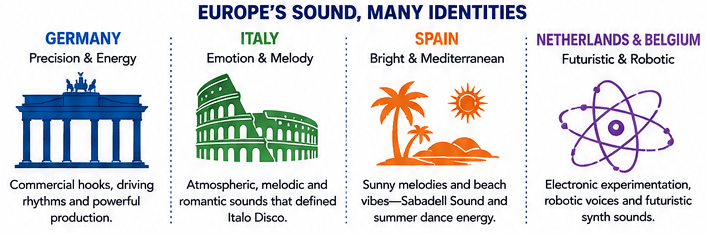
- Key Regions: Germany brought precision and energy, Italy added emotional melody (Italo Disco), Spain added bright summer-style sounds, and the Netherlands introduced futuristic and robotic experimentation.
- Studio Culture: Many artists were producer-driven projects, where studio teams created multiple acts and aliases across different labels and collaborations.
- Influence: Euro Disco helped shape Italo Disco, Hi-NRG, Eurodance, Euro House, and later inspired modern retro and synthwave movements.
- Radio & DJ Culture: 12-inch singles, compilation albums and late-night radio shows were key in spreading the sound across Europe and beyond.
- Today: Euro Disco remains popular through vinyl collectors, DJ sets, online radio and retro revival scenes.
- Listen Today: You can still enjoy this sound on Spotify and dedicated stations such as MixPerfect Radio, where Euro Disco, Italo Disco and Hi-NRG classics continue in a nonstop DJ mix format.
What Is Euro Disco?
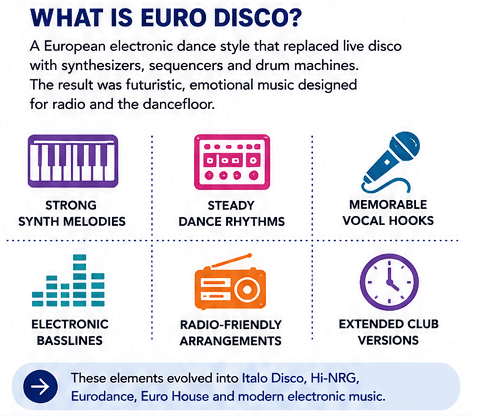
Euro Disco is a European electronic dance style that emerged in the late 1970s and expanded rapidly during the early and mid-1980s.
Unlike traditional American disco, which relied heavily on live bands and funk influences, European producers increasingly replaced musicians with synthesizers, sequencers and drum machines.
This change transformed dance music completely. Instead of large studio bands, producers could create songs using electronic equipment, giving them greater control over arrangement, rhythm and atmosphere.
The result was music that felt futuristic and emotional at the same time.
- Strong synthesizer melodies
- Steady dance rhythms
- Simple memorable vocal hooks
- Electronic basslines
- Radio-friendly arrangements
- Extended club versions for DJs
These characteristics later evolved into styles including Italo Disco, Hi-NRG, Eurodance and many forms of modern electronic music.
How Europe Rebuilt Disco Through Technology
When disco began losing commercial momentum in the United States near the end of the 1970s, European producers moved in a different direction. Rather than abandoning dance music, they started rebuilding it with technology.
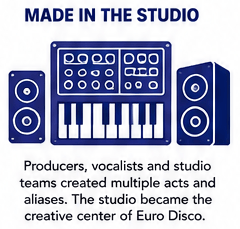
Studios increasingly used electronic instruments such as synthesizers and programmable drum machines. This allowed producers to create cleaner rhythms, more precise arrangements and sounds that would have been difficult to achieve with traditional bands.
The shift also changed how artists were created.
Many successful projects were producer-driven. In some cases, the people seen in videos and photographs were not always the musicians or singers who created the recordings. The studio itself became the center of creativity.
That approach later became normal throughout dance music.
Germany: The Engine Room of Commercial Euro Disco
Germany became one of the strongest production centers within the Euro Disco movement. German productions often emphasized precision, powerful hooks and highly structured arrangements designed for radio and club play.
Compared to some Italian productions that leaned heavily toward atmosphere and emotion, German tracks often felt more direct and energetic.
Fancy: Artist, Producer Alias and Studio Projects
Fancy (real name: Manfred Alois Segieth) became one of the most recognizable names in the Euro Disco and Hi-NRG scene.
Some of his best-known hits include:
- Slice Me Nice
- Chinese Eyes
- Bolero (Hold Me in Your Arms Again)
- Lady of Ice
- Flames of Love
- Get Lost Tonight
However, his influence went beyond his own artist identity. Like many studio-driven producers of the 1980s, Manfred also worked under different aliases (with “Tess” being his most well-known pseudonym) and contributed to multiple studio projects that were released under various group names.
These productions were often created in collaboration with other musicians, vocalists and studio teams, reflecting the producer-driven nature of European dance music at the time.
Projects and related acts include:
- The Hurricanes - Studio project connected to the European synth and dance scene with melodic electronic arrangements. Example tracks: "Only One Night", "Dance With Me"
- Linda Jo Rizzo - American-born singer who became highly associated with the German Italo Disco and Euro Disco scene. Example tracks: "You're My First, You're My Last", "Heartflash (Tonight)", "Perfect Love"
- Timerider - Electronic dance project known for strong synth melodies and classic mid-1980s production. Example tracks: "Cocoon", "Invader", "Space Iwan"
- Grant Miller - Popular Euro Disco and Italo-style vocalist with energetic dance productions. Example tracks: "Colder Than Ice", "Red For Love", "Doctor For My Heart"
- Mozzart - Studio project blending catchy pop hooks with Euro Disco production techniques. Example tracks: "Money", "Jasmin China Girl", "Devil's Rendezvous"
This network of aliases and studio projects helped define the broader Euro Disco ecosystem, where producers often shaped multiple “artist identities” simultaneously.
Mike Mareen: Producer, Performer and Studio Collaborator
Mike Mareen (real name: Uwe-Michael Wischhof) is a German singer, songwriter and producer who played an important role in the Euro Disco and Hi-NRG scene during the 1980s. His sound combined driving electronic rhythms with melodic hooks and strong club energy, making him a regular name in both European charts and dance floors.
Some of his best-known hits include:
- Love Spy
- Dancing in the Dark
- Agent of Liberty
- Lady Ecstasy
- Don't Talk To The Snake
Beyond his solo career, Mareen was also active as a producer and collaborator on various studio projects, often working under different aliases in the wider Italo and Euro Disco network.
Associated projects and collaborations include:
- DJ's Project - Electronic studio project connected to the European dance scene with synth-driven arrangements. Famous tracks: "Vision Of Love", "Birthday girl", "How Are You"
- Shipra - Dance-oriented studio project associated with melodic 1980s electronic productions. Famous tracks: "Blinded By Love", "Fantasy Girl"
- Amadeus Liszt - Synth-based project using orchestral-inspired themes mixed with electronic dance production. Famous tracks: "Win The Race", "The Devil Wins"
Some of Mike Mareen's best-known solo songs include "Love Spy", "Agent Of Liberty", "Dancing In The Dark" and "Don't Talk To The Snake", tracks that became recognizable releases within the Hi-NRG and Euro Disco scene of the 1980s.
Italy: The Emotional Heart of Euro Disco and Italo Sound
While Germany often focused on precision and commercial structure, Italy developed a more atmospheric and emotional interpretation of electronic dance music. Italian producers emphasized melody, romantic themes and layered synthesizer arrangements that created a distinctive sound later widely associated with Italo Disco.
The Italian scene helped transform Euro Disco from purely dance-oriented music into something more cinematic and emotionally expressive.
Gazebo: Atmospheric Melodies and Sophisticated Production
Gazebo became internationally known through tracks that blended electronic arrangements with softer vocal styles and emotional songwriting.
His music introduced a more reflective side to the Euro and Italo movement, proving that dance music could also create atmosphere and mood.
Essential tracks:
- I Like Chopin
- Masterpiece
- Love In Your Eyes
Instead of relying on aggressive club energy, Gazebo's productions focused on elegant melodies and memorable emotional themes.
Savage: Emotional Darkness and Melancholic Synth Music
Savage brought a darker and more emotional direction into the European dance scene. His recordings often explored themes of longing, loneliness and romantic distance.
This emotional intensity became one of the defining characteristics of many classic Italo Disco productions.
Essential tracks:
- Only You
- Don't Cry Tonight
- A Love Again
Even decades later, these tracks remain staples on retro dance stations and collector compilations.
Ken Laszlo: High-Energy Italian Dance Production
Ken Laszlo represented the more energetic and commercial side of the Italian electronic movement.
His productions combined catchy vocal hooks with faster rhythms designed for clubs, radio rotation and dance compilations.
Essential tracks:
- Hey Hey Guy
- Tonight
- Don't Cry
His style helped bridge melodic Italo Disco with the faster energy that later appeared in Eurodance.
Spain: Bright Melodies and Mediterranean Energy
Spain developed its own interpretation of Euro Disco during the 1980s: Sabadell Sound. Influenced by nightlife, tourism culture and imported dance records, Spanish productions often sounded brighter and more accessible.
Many tracks carried a strong summer atmosphere and became closely associated with beach clubs and late-night radio shows.
David Lyme and the Spanish Dance Identity
David Lyme became one of the most recognizable artists connected with Spain's contribution to the Euro Disco movement.
His productions combined rhythmic basslines, memorable synthesizer melodies and accessible song structures.
Essential tracks:
- Bambina
- Playboy
- Let's Go To Sitges
- I don't wanna lose you
- Bye Bye Mi Amor
His music became strongly connected with the lighter, melodic side of European dance culture.
Other Spanish Euro Disco Projects
Besides David Lyme, Spain produced several other notable studio-driven acts that contributed to the European synth and Italo-influenced dance sound of the 1980s.
Alan Cook
Alan Cook is associated with melodic Euro Disco and Italo-influenced productions coming from the Spanish studio scene. His music typically focused on emotional vocals combined with synth-driven arrangements, fitting closely within the radio-friendly side of European dance music.
Squash Gang
Squash Gang was a Spanish studio project known for its energetic Italo Disco style and catchy synth hooks. The project is often associated with the late 1980s Euro Disco wave, blending dancefloor energy with melodic structures.
Kristian Conde
Kristian Conde contributed to the Spanish Italo Disco movement with productions that emphasized strong electronic basslines and melodic synthesizer lines. His work reflects the transition from classic Euro Disco toward more club-oriented electronic dance music.
Together with David Lyme, these artists helped define the Spanish contribution to the broader Euro Disco and Italo-inspired European electronic scene, often characterized by bright melodies, summer-like atmospheres and strong radio appeal.
The Netherlands: Futuristic Electronic Experiments
Dutch and Belgian producers often pushed electronic production into more experimental territory.
Rather than focusing entirely on romantic themes, many projects explored futuristic sounds, robotic voices and heavy synthesizer programming.
These ideas later influenced spacesynth and several electronic subgenres.
Digital Emotion and Robotic Euro Disco
Digital Emotion became one of the most recognizable Dutch electronic projects of the 1980s Euro Disco era.
The project was created by the Dutch production team Adams & Fleisner, who were responsible for the overall sound, composition and studio production.
The male vocals were originally performed by members of Adams & Fleisner themselves, particularly Cees R. Bergman, while the female vocal parts were provided by the Dutch trio The Internationals.
All instruments were played, recorded and mixed within the Adams & Fleisner studio production setup, reflecting the fully studio-driven approach that defined many Euro Disco projects of that period.
Their sound stood apart because of robotic vocal effects, strong rhythm programming and futuristic themes.
Essential tracks:
- Get Up Action
- Go Go Yellow Screen
- Don't Stop
Their music represented a more technological and experimental side of European dance music and became particularly popular among DJs, collectors and early electronic music enthusiasts.
Hotsound Records: Dutch Independent Label and the Foundation of Spacesynth Culture
Hotsound Records is a Dutch electronic music label founded in 1981 by Erik van Vliet in Rotterdam, The Netherlands. The label became an important part of the Dutch and European electronic music scene during the 1980s and beyond.
In its early years, the label was closely connected to the emergence of instrumental electronic projects and synth-driven dance music. One of the most notable early developments was the creation of Laserdance. This project became one of the defining acts of the spacesynth direction that followed Euro Disco and Italo Disco influences.
Over time, Hotsound expanded its catalog with a wide range of electronic productions, including projects such as Syntech, Gotcha!, Sisley Ferré, Kim Taylor and Primero, among others. These releases helped establish the label as a consistent name within the international synth and dance music community.
Because of its long-term activity and strong connection to instrumental electronic music, Hotsound is often seen as a bridge between classic Euro Disco, Italo Disco and later spacesynth and retro electronic revival scenes.
Bobby O and the Hi-NRG Connection
Although Euro Disco developed mainly in Europe, American Hi-NRG production also played a crucial role in shaping its evolution. One of the most influential figures in this crossover was Bobby O (Bobby Orlando), a producer who helped define the fast, synth-driven club sound of the early 1980s.
His productions introduced a more aggressive and energetic electronic style built around driving basslines, sharp drum machine programming and repetitive, highly danceable hooks. This approach strongly influenced European producers working in Euro Disco, Italo Disco and later Hi-NRG and Eurodance scenes.
Beyond his own releases (“She Has a Way”, “I’m So Hot for You“), Bobby O also worked as a producer and songwriter for various studio projects and side acts that became part of the wider Hi-NRG and Euro Disco ecosystem.
Notable Bobby O - related productions and projects include:
- Pet Shop Boys - early production involvement on demo-era material (including “West End Girls” early versions)
- The Flirts - “Passion”, “Helpless”, “Jukebox (Don’t Put Another Dime)”
- Divine - “Native Love (Step by Step)”, “Shoot Your Shot”
These productions were often created in a studio-driven environment where vocalists, musicians and performers were assembled around a central production concept, rather than functioning as traditional bands.
This production model had a strong impact on European dance music, encouraging a shift toward producer-led projects and shaping the structure of many later Euro Disco and Eurodance hits.
How Radio Turned Euro Disco Into an International Movement
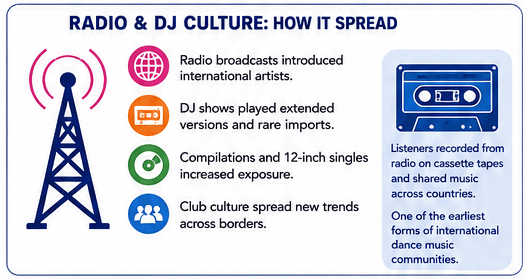
Long before streaming platforms existed, radio stations became the main discovery engine for electronic dance music.
Listeners often recorded songs directly from broadcasts onto cassette tapes, creating personal collections and sharing music between countries.
Late-night DJ shows played a particularly important role because they frequently featured extended versions and imported dance records that were difficult to find in local stores.
- Radio broadcasts introduced international artists
- DJ programs promoted extended versions
- Dance compilations increased exposure
- Club culture spread new trends across borders
This system created one of the earliest forms of international dance music communities.
Record Labels and Producers That Built the Euro Disco Sound
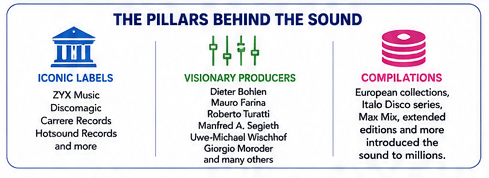
Behind almost every successful Euro Disco release stood a network of producers, labels and studio teams. During the 1980s, record labels did far more than distribute music. They shaped trends, organized compilations and determined which songs reached radio stations and clubs across Europe.
Many listeners remember artists first, but producers and labels often operated behind the scenes as the real engine of the movement.
ZYX Music and European Dance Distribution
ZYX Music became one of the most important companies connected with Euro and Italo-oriented dance music. Through compilations, licensing agreements and large music catalogs, the label helped spread electronic dance releases across multiple countries.
Its compilation series later became essential listening for collectors and fans of classic synth-based dance music.
Discomagic and the Italian Dance Explosion
Italian labels helped transform regional electronic projects into internationally recognized releases. Discomagic played a major role in expanding the reach of melodic Italian productions during the 1980s.
Many artists who later became associated with classic Italo Disco gained broader exposure through compilation releases and international distribution networks.
Carrere Records and European Pop Dance
French label Carrere Records also played a role in distributing dance-oriented productions across Europe. The company released both commercial pop and electronic dance material that helped connect regional markets.
Its international reach made it easier for songs to move beyond local audiences and reach radio stations throughout Europe.
The Producers Behind the Sound
While artists stood in front of microphones, many of the most recognizable Euro Disco sounds came from a relatively small group of producers working behind the scenes.
- Dieter Bohlen - Known for creating highly commercial melodic productions and for producing Modern Talking, C.C. Catch and multiple other European pop projects.
- Mauro Farina - One of the most active Italian producers and songwriters, involved in numerous Italo and Euro Disco productions.
- Roberto Turatti - Producer and songwriter who collaborated on many classic Italian dance releases.
- David Brandes - German producer connected with commercial Euro and dance-pop productions.
- Manfred Alois Segieth - Besides his own hits, he also worked behind the scenes on various studio projects and productions.
- Uwe-Michael Wischhof - Combined artist work with production and collaboration across multiple studio identities.
- Giorgio Moroder - Although often associated with earlier electronic disco development, his production techniques heavily influenced the later Euro Disco sound.
The Importance of Compilation Albums
Before music streaming and online playlists existed, compilation albums acted as discovery platforms for electronic dance music.
For many listeners, compilations became the easiest way to hear music from other countries. A single album could combine German synth productions, Italian melodies, Spanish dance tracks and underground electronic projects.
Popular formats often included:
- European dance collections - Broad multi-artist releases featuring commercial dance music from different countries. Examples include "The Best Of Euro Disco", "Disco Dance Classics" and various "Super Euro Hits" collections.
- Italo Disco compilations - Collections focused specifically on Italian synth-driven dance music. Examples include "ZYX Italo Disco Collection", "The Best Of Italo Disco" and "I Love ZYX - Italo Disco Collection".
- DJ mixed albums - Continuous mixed albums where tracks blended together instead of appearing as separate songs. Examples include "Max Mix", "Bolero Mix" and various club-oriented megamix releases.
- Extended dance editions - Albums built around longer club versions and 12-inch mixes. Examples often included "Extended Versions", "12 Inch Dance Collection" and maxi-single collections.
- Label-focused collections - Releases highlighting the catalog of a specific company or production team. Examples include "Discomagic Compilation" and "The Best Of Hotsound".
These albums helped listeners discover artists they would otherwise never encounter through local radio stations.
DJ Culture and the Power of the 12-Inch Single
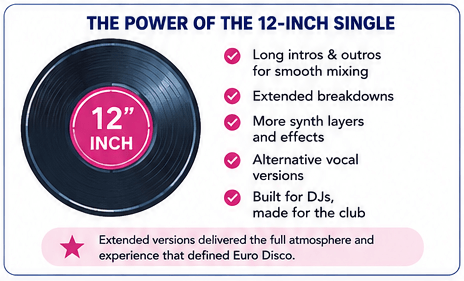
Euro Disco was strongly connected to DJ culture and club environments. One of the most important formats during the 1980s was the 12-inch single.
Unlike standard radio versions, extended releases gave DJs more freedom for mixing and transitions.
Typical features of a 12-inch release included:
- Long instrumental introductions
- Extended breakdown sections
- Additional synthesizer layers
- Long rhythmic passages
- Alternative vocal versions
Many listeners today still prefer extended versions because they preserve the full atmosphere and progression of classic Euro Disco productions.
The popularity of continuous mixing on modern internet radio can be traced directly back to these longer club-oriented arrangements.
How Euro Disco Evolved Into New Electronic Genres
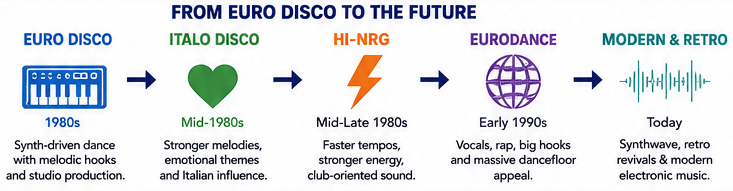
By the late 1980s and early 1990s, music technology and club culture started changing rapidly. New equipment became available, production techniques improved and dance audiences increasingly wanted stronger rhythms and more energetic sounds.
Instead of disappearing, Euro Disco evolved into several new directions.
Main Evolution Paths
- Italo Disco - stronger melodic identity and emotional themes
- Hi-NRG - faster tempos and stronger club energy
- Euro House - house rhythms combined with melodic structures
- Eurodance - vocal hooks, rap elements and stronger bass production
- Synthwave and retro electronic music - modern revival inspired by 1980s sounds
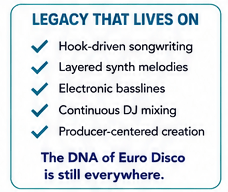
Even modern dance music still uses many ideas that became popular during the Euro Disco era:
- Hook-driven songwriting
- Layered synthesizer melodies
- Electronic basslines
- Continuous DJ mixing
- Producer-centered music creation
Essential Euro Disco and Related Classics
The following tracks represent some of the most influential and recognizable songs connected to the Euro Disco movement and its closely related styles.
- Gazebo - I Like Chopin
- Modern Talking - You're My Heart, You're My Soul
- Silver Pozzoli - Around My Dream
- CC Catch - Cause You Are Young
- Ryan Paris - Dolce Vita
- Den Harrow - Future Brain
- Mike Mareen - Love Spy
- Savage - Don't Cry Tonight
- Fancy - Bolero
- Righeira - Vamos A La Playa
- Laserdance - Humanoid Invasion
- Bad Boys Blue - You're A Woman
- Fun Fun - Happy Station
- David Lyme - Bambina
- Silent Circle - Touch In The Night
- Radiorama - Chance To Desire
- Ken Laszlo - Tonight
- Digital Emotion - Go Go Yellow Screen
- P. Lion - Happy Children
- Valerie Dore - The Night
- Scotch - Disco Band
- The Flirts - Passion
- Miko Mission - How Old Are You
- Eddy Huntington - U.S.S.R.
- Baltimora - Tarzan Boy
- Lian Ross - Fantasy
- Baccara - Yes Sir I Can Boogie
- Patrick Hernandez - Born to Be Alive
- Amanda Lear - Follow Me
- Sandra - (I'll Never Be) Maria Magdalena
- Joy - Touch by Touch
- Patty Ryan - You're My Love, You're My Life
- Donna Summer - I Feel Love
- Boney M. - Rasputin
- Laura Branigan - Gloria
- Mozzart - Money
- Sisley Ferré - Give Me Your Love
- John Mendes - Love Is The Reason
- Attack - Crazy For Your Love
- Gazuzu - Go Go Gorilla
- Nathalie - My Love Won't Let You Down
- Winder - Run For Love
- Curacao - Yiasou
- Rofo - Flaslight On A Disco Night
- Laban - Love In Siberia
- Company B - Fascinated
- Michael Fortunati - Into The Night
- Costas Charitodiplomenos - Lost In The Night
- Fresh Color - Sing With Me Tonight
Why Euro Disco Never Really Disappeared
Euro Disco did more than create dance hits. It transformed how music was produced, distributed and experienced.
The movement connected German precision, Italian melody, Spanish atmosphere and Dutch electronic experimentation into a sound that crossed borders and generations.
Today its influence remains visible in retro radio stations, synthwave culture, modern electronic music and continuous DJ mixes.
Long after the analog synthesizers and cassette recordings of the 1980s faded from everyday use, the music itself kept moving.
And somewhere, late at night, those synthesizers are still playing.
You can still enjoy this sound today on Spotify and dedicated radio stations such as MixPerfect Radio, where Euro Disco, Italo Disco and Hi-NRG classics are kept alive in a nonstop DJ mix.
