
Italo Disco Radio: Guide to the Iconic 80s Dance Genre
Italo Disco is one of the most iconic European electronic music genres of the 1980s, known for its melodic synthesizers, emotional vocals, and futuristic dance sound that defined an entire era.
Today, Italo Disco radio online keeps this sound alive through 24/7 streaming, DJ mixes, and curated collections of classic and modern Italo-inspired tracks - including stations like MixPerfect Radio.
Explore the origins, signature sound, key artists, and lasting global influence of Italo Disco - a genre that helped shape modern electronic music and continues to thrive in digital radio, vinyl culture, and contemporary productions.
Quick Summary: Italo Disco Radio
- Origin: Italo Disco started in Italy in the late 1970s and early 1980s as electronic disco evolved with synthesizers and drum machines.
- Sound: Melodic synths, catchy hooks, driving basslines, and emotional vocals - often with futuristic or romantic themes.
- Golden Era: The genre peaked during the 1980s and became a defining sound across European clubs and radio.
- Global Impact: Italo Disco spread far beyond Italy, gaining popularity in countries like Germany, the Netherlands, and Japan.
- Unique Style: Known for its “imperfect” English lyrics, strong melodies, and distinctive electronic production.
- Influence: Helped shape later genres such as Italo Dance, Eurodance, synthwave, and modern EDM.
- Today: Still alive through online radio, vinyl collectors, DJ sets, and a growing global revival scene.
What is Italo Disco Radio?
Italo Disco radio refers to online and broadcast radio stations dedicated to playing Italo Disco music, a genre that originated in Italy in the late 1970s and early 1980s.
These stations focus on continuous streams of classic Italo Disco tracks, rare vinyl releases, extended DJ mixes, and modern productions inspired by the original sound.
Unlike mainstream radio formats, Italo Disco radio stations are niche-focused and built around a specific musical culture, preserving the golden era of European electronic dance music while introducing it to new generations.
The Origins of Italo Disco
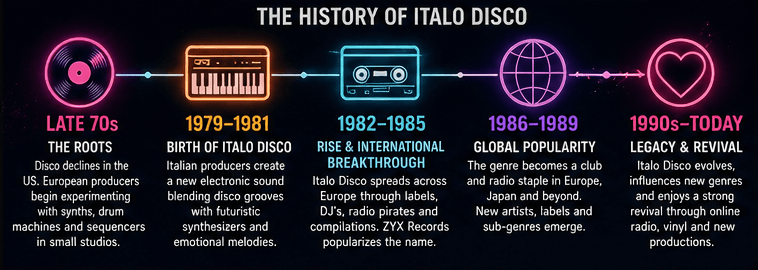
Italo Disco emerged in Italy in the late 1970s and early 1980s during the transition from traditional disco to electronic dance music. As disco declined in the United States, European producers began experimenting with synthesizers, drum machines, and sequencers.
Working in small independent studios with limited budgets, Italian producers created a futuristic yet emotional sound that combined disco grooves with electronic textures. Influences from pioneers such as Giorgio Moroder helped shape this new direction in dance music.
A key factor in the rise of Italo Disco was the rapid development of affordable home and studio electronics in Europe. Instruments like the Roland TR-808, Roland TR-909, and early Yamaha DX synthesizers made it possible for small studios to produce full dance tracks without the need for large orchestras or expensive recording sessions.
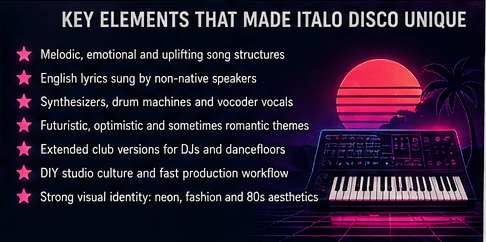
Many early Italo Disco productions were recorded in Milan, Rome, and Bologna, where independent labels and small studios worked closely with local session musicians and engineers. This “do-it-yourself” studio culture helped the genre evolve quickly and allowed producers to release music at a very high volume compared to traditional pop production of the time.
How the Name “Italo Disco” Was Created
The term “Italo Disco” was not originally an official genre name in Italy. Early productions were simply referred to as disco or electronic disco and were categorized by individual record labels rather than a unified style.
The name became widely established in the early 1980s through the work of German record label ZYX Records, founded by Bernhard Mikulski. Through influential compilation series such as The Best of Italo Disco, the label grouped Italian electronic dance tracks under a single recognizable name.
Mikulski played a key role in the international spread of the term by distributing these compilations across Europe, especially in Germany, where DJs, record stores, and radio stations quickly adopted “Italo Disco” as a convenient way to categorize this emerging sound.
Although the term was not invented by a single artist or producer, ZYX Records and Bernhard Mikulski were instrumental in standardizing it and turning it into a globally recognized genre label.
Over time, “Italo Disco” became the definitive name for this style of 1980s European electronic dance music, although the genre has also been described using alternative names such as “italian disco“, “spaghetti disco”, “spaghetti dance” and simply “Italo”.
The Signature Sound of Italo Disco
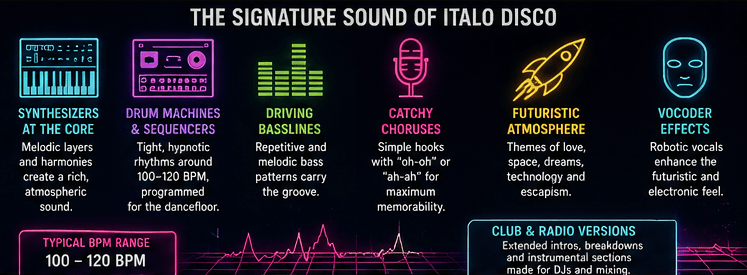
Italo Disco is instantly recognizable due to its strong melodic focus and electronic production style. It combines emotional songwriting with synthetic, futuristic arrangements that were highly innovative for its time.
- Synthesizers at the core - melodic leads and harmonic layers dominate the sound, often creating a rich, atmospheric texture.
- Drum machines and sequencers - tight, hypnotic rhythms around 100 - 120 BPM, typically programmed rather than played live.
- Driving basslines - repetitive but melodic bass patterns that often carry the groove of the entire track.
- Catchy choruses - simple hooks often featuring “oh-oh” or “ah-ah” vocal refrains designed for maximum memorability.
- Bright, uplifting melodies - emotional yet energetic compositions that often contrast melancholic lyrics.
- Futuristic themes - lyrics about love, dreams, space, technology, and escapism.
- Vocoder effects - robotic or processed vocals used to enhance the futuristic atmosphere.
A typical Italo Disco arrangement often builds gradually, starting with drum and bass elements, then introducing synthesizer layers, vocal hooks, and finally extended instrumental sections designed for club DJs. Many tracks were also released in extended “club versions” with long intros and breakdowns for mixing purposes.
The Charm of Imperfect English Vocals
Many Italo Disco tracks feature English lyrics sung by non-native speakers. This often resulted in unusual grammar, pronunciation, and phrasing that differed from standard English pop productions.
Rather than being a weakness, this became one of the genre’s defining charms. The emotional delivery and sincerity made the vocals memorable and unique, adding personality and authenticity to the music.
In many cases, lyrics were written directly in Italian and then translated loosely into English, or even improvised during recording sessions. This contributed to poetic, sometimes abstract lyrics that prioritized feeling and melody over grammatical correctness.
Over time, this “imperfect English” became a recognizable stylistic trademark of Italo Disco and is now considered an essential part of its nostalgic appeal.
Radio Pirates in the Netherlands
In the Netherlands, Italo Disco became popular thanks to pirate radio stations. These underground broadcasters played imported records that were not available on mainstream radio, helping build a strong and dedicated fanbase.
Stations operating offshore or outside official licensing regulations often had more freedom in their playlists, which allowed them to introduce niche European dance music to Dutch listeners. Italo Disco fit perfectly into these broadcasts due to its energetic and melodic character.
For many fans, these pirate stations were the first point of contact with the genre, long before it appeared in mainstream clubs or official radio programming. This grassroots exposure played a major role in establishing the Netherlands as one of the key European markets for Italo Disco.
Italo Disco as an International Export

Although Italo Disco originated in Italy, it became far more successful abroad than at home. It evolved into a true export product with strong followings across multiple regions.
One of the key reasons for this international success was the role of European distribution networks, compilation albums, and DJs who actively promoted imported records across borders. This helped the genre spread quickly through clubs and radio stations outside Italy.
- Western & Northern Europe - especially Germany, the Netherlands, Belgium, and Scandinavia, where the genre became a club and radio staple
- Eastern Europe - strong underground popularity, often sustained through radio, cassette culture, and later vinyl trading
- Japan - long-lasting club culture and a dedicated fanbase that continues to support Italo Disco releases and reissues
- South America - especially Argentina and Chile, where melodic European dance music gained strong emotional appeal
- North America - more niche, but influential within specific club and underground dance scenes
Italo Disco Radio Themed Songs
Radio stations were essential to the rise of 'Spaghetti Disco' during the 1980s. The connection between disco from Italy and radio culture became so strong that some artists even turned the atmosphere of radio itself into a theme for their music:
- taffy - i love my radio
- eddy trauba & m.m. greco - maccaroni radio
- carlo conti - radio
- nobel - turn on you radio
- jersey college group - my radio
- red dragon band - let me be your radio
- band of jocks - we love radio
- karin clark - radio man
- bon ton - video killed the radio star
- gee ramply - radio star
- between the sheets - late night radio
- den harrow - broken radio
- jane hill - radio
- rudy & co. - mama radio
- p. lion - reggae radio
- savage -radio
The Importance of “I Venti d’Azzurro”
I Venti d’Azzurro is a cornerstone of the Italo Disco phenomenon, born from a deep-rooted Dutch DJ, radio, and collector culture. Rather than starting as a retrospective project, it began as a trendsetting force driven by Marcello d’Azzurro’s (Marcel van den Belt) fierce dedication to the genre. He became a pivotal figure by fanatically promoting Italo Disco on the radio, bringing the latest Italian sounds directly to the airwaves.
Driven by this relentless radio promotion, his MB Charts and I Venti d’Azzurro Charts reached legendary status among enthusiasts, particularly in the Haag-Rotterdam-Westland region. These charts were the definitive pulse of the scene, dictating the playlists of local stations and clubs. Their influence was so significant that even Italian producers viewed them as a crucial barometer for success; a high ranking in Marcello’s charts was seen as a definitive seal of quality and a sign of a potential international hit.
Building on this legacy, Marcello achieved further international success with his label, I Venti d’Azzurro Records. The label has become a powerhouse in the global community, meticulously reissuing classic 80s hits for collectors while also producing brand-new releases featuring iconic artists from the original 1980s era.
Marcello’s involvement extended far beyond curation and broadcasting; he also wrote and performed Eurobeat songs under several successful aliases, releasing numerous tracks across Europe - achieving notable success especially in Japan - under projects such as:
- NRG Boys
- Marc B.
- 2-Get-Her
- Marc & Susy
This unique synergy between fanatical radio promotion, industry-leading charts, and a successful record label made Marcello d’Azzurro an essential architect of the genre. By bridging the gap between the FM airwaves and the recording studios, he established “I Venti d’Azzurro” as the gold standard for Italo Disco worldwide.
Mainstream Artists & Global Hits
Ryan Paris - “Dolce Vita”, one of the defining Italo Disco classics across Europe
Gazebo - “I Like Chopin”, a major international hit blending synth-pop and classical influences
Valerie Dore - “The Night”, a mysterious and atmospheric Italo Disco classic with haunting melodies and one of the genre’s most iconic productions
Koto - “Visitors”, an iconic instrumental track known for its futuristic sound and major influence on spacesynth
Scotch - “Disco Band”, a high-energy dancefloor classic
- Miko Mission - “How Old Are You?”, one of the most iconic melodic Italo tracks
- Baltimora - “Tarzan Boy”, a global crossover success reaching charts worldwide
- Raf - “Self Control”, a widely recognized hit later covered internationally
- P. Lion - “Happy Children”, a timeless melodic Italo anthem
- My Mine - “Hypnotic Tango”, a club favorite with strong international appeal
- Den Harrow - “Future Brain”, one of the genre’s most recognizable productions
- Righeira - “Vamos A La Playa”, a summer hit with global popularity
- Silver Pozzoli - “Around My Dream”, a melodic and widely played Italo track
- Gary Low - “La Colegiala”, a smooth and widely popular track with international success
- Fun Fun - “Happy Station”, an energetic and catchy Italo Disco hit
- Taffy - “I Love My Radio”, a classic Italo anthem strongly associated with radio culture
- Radiorama - “Desire”, a high-energy production with strong international club appeal
- Martinelli - “Cenerentola”, a distinctive and atmospheric Italo Disco classic
- Sabrina - “Boys (Summertime Love)”, a catchy Italo-inspired pop-dance classic known for its highly talked-about music video, which contributed strongly to its success in the late 1980s
- Ken Laszlo - “Tonight”, a classic Italo Disco track featuring a joyful, upbeat 1980s sound with catchy synth melodies and its well-known “oh oh” style vocal hook
These artists and tracks represent the golden era of Italo Disco, when Italian productions dominated European dance floors and gained international success. Many of these songs remain essential in DJ sets, Italo Disco radio stations, and modern revival events today.
Record Labels That Defined the Genre
The Italo Disco sound was heavily shaped by a network of independent Italian and European record labels. These labels were responsible for producing, funding, and distributing thousands of releases, often working closely with studio producers to create fast-turnaround dance music projects.
- Discomagic Records - one of the most prolific Italo Disco labels, founded by Severo Lombardoni, responsible for a huge number of releases and closely tied to the Milan-based studio scene
- ZYX Records - German label led by Bernhard Mikulski that popularized the term “Italo Disco” through its influential The Best of Italo Disco compilation series and exported the sound across Europe
- Memory Records - influential Italian label foundedby Alessandro Zanni and Stefano Cundari, known for its strong focus on synthesizer-driven and instrumental Italo Disco, launching projects such as Koto, Cyber People, and Hipnosis
- Baby Records - major Italian label with strong international distribution, releasing crossover hits like Gazebo and contributing to the commercial success of Italo Disco
- Il Discotto Productions - one of the largest Italo Disco labels and distribution companies of the 1980s, founded by Roberto Fusar-Poli in 1982, releasing major artists like Gary Low, Scotch and Doctor’s Cat, and known for its early electro-influenced sound and key role in the Milan-based Italo scene
- X-Energy Records - independent Italian label, active from the early Italo Disco era through the Eurodance and house periods, releasing hits such as Fun Fun’s “Happy Station” and later global successes like Whigfield’s “Saturday Night” and Benny Benassi’s “Satisfaction”
- Time Records - founded by Giacomo Maiolini, this label became crucial in bridging Italo Disco into Eurobeat and later international dance markets, especially Japan
- Goody Music Records - early Italian disco label (founded by Jacques Fred Petrus) that helped lay the groundwork for the later Italo Disco sound through funk, boogie, and electronic influences
Together, these labels formed the backbone of the Italo Disco industry. Their fast, producer-driven model allowed an extremely high output of music, shaping not only the genre itself but also its global distribution and long-term legacy.
Legendary Producers
The sound and global success of Italo Disco were largely driven by a small but highly influential group of producers. These figures worked behind the scenes in studios, shaping arrangements, guiding studio vocalists, and creating entire musical projects that often existed as production concepts rather than traditional bands.
- Giorgio Moroder - pioneer of electronic disco and a major influence on the development of Italo Disco and synth-based dance music worldwide
- Mauro Farina - extremely prolific producer and vocalist behind hundreds of Italo Disco and Eurobeat tracks, often working through the SAIFAM studio system
- Giuliano Crivellente - key collaborator in the SAIFAM production network, helping shape the high-energy and melodic Italo sound
- Roberto Zanetti (Savage) - singer and producer who created some of the most emotional and melodic Italo Disco productions of the era
- Roberto Turatti - influential Italian producer known for club-oriented Italo and Hi-NRG productions
- Miki Chieregato - key studio producer who worked closely with Turatti on many classic Italo Disco projects
- Gino Caria - Italian producer involved in melodic Italo and Eurobeat productions, contributing to several studio projects during the genre’s peak
- Stefano Cundari - co-founder of Memory Records and influential figure in shaping the melodic and emotional direction of Italo Disco
- Aldo Martinelli - producer and composer behind many classic Italo Disco projects, known for his strong melodic songwriting style
These producers played a crucial role in defining the genre’s identity. Their studio-driven approach allowed them to release music under multiple project names, shaping the Italo Disco industry through fast, high-volume production and a strong focus on melody and atmosphere.
Famous Studio Singers Behind Italo Disco
Many Italo Disco tracks were performed by professional studio singers working behind fictional artist names. In many cases, one voice could appear across dozens of different projects, often recorded for multiple producers and labels. This studio-driven system became one of the defining characteristics of the genre.
- Thomas Beecher Hooker - real vocals behind many Den Harrow tracks and other Italo projects
- Clara Moroni - prolific studio vocalist featured in countless Italo Disco and Eurodance productions
- Mauro Farina - singer, producer, and voice behind many SAIFAM studio projects under various aliases
- Giancarlo Pasquini - iconic Eurobeat and Italo voice, also active as a major producer under multiple project names
- Dora Carofiglio - vocalist behind projects such as Valerie Dore and many other Italo productions
- Gino Caria - Italian vocalist and studio singer who contributed to several Italo Disco and Eurobeat productions during the genre’s peak
- Alberto Carpani - Italian singer and Italo Disco artist known for hits like “Turbo Diesel” and “Heart on Fire”, and also active in studio-based productions
These singers and vocal contributors formed the hidden backbone of Italo Disco, providing vocals for countless fictional artist names and studio projects. Their work helped define the emotional and melodic identity of the genre, even when they were not always publicly credited.
Where Italo Disco Was Popular
Italo Disco quickly spread beyond Italy and became a defining sound across much of Europe during the 1980s. Countries like Germany, Spain, France, the Netherlands, and Belgium embraced the genre through clubs, radio stations, and early dance compilations.
Outside Europe, the genre also found a surprisingly strong following in Japan, where its polished electronic sound matched the growing interest in synth-based pop and club music. In parts of Eastern Europe, Italo Disco circulated through radio broadcasts and cassette culture, becoming a symbol of Western electronic music during the late Cold War era.
In South America, especially in countries like Argentina and Brazil, the genre developed a loyal underground fanbase. Imported records, DJ culture, and later retro revival scenes helped maintain its presence long after its peak in the 1980s.

Today, these international communities continue to keep the genre alive through online radio stations, collector scenes, and nostalgic club nights dedicated to Italo Disco’s distinctive sound.
The Modern Revival of Italo Disco
Today, Italo Disco continues to thrive through online radio, streaming platforms, vinyl reissues, and modern producers inspired by the 1980s sound. What was once a largely European underground movement has developed into a global revival culture with an active and dedicated fanbase.
A major driver of this revival is internet radio and specialist DJ stations, where classic tracks are played alongside newly produced Italo-inspired music. Vinyl collectors have also played a key role, with original pressings and reissues becoming highly sought after in the global DJ community.
In addition, modern producers have embraced the Italo Disco aesthetic, combining vintage synthesizer sounds with contemporary production techniques. This has led to a wave of new music that blends nostalgia with modern electronic genres such as synthwave, nu-disco, and retro-electro.
Italo-themed events, club nights, and festivals across Europe continue to attract both original fans and new generations. These gatherings often feature classic DJs, vinyl-only sets, and live performances that celebrate the history and evolution of the genre.
Flemming Dalum and the Art of Italo DJ Mixing
Danish DJ Flemming Dalum is widely recognized as one of the most influential figures in preserving and promoting Italo Disco culture. Known for his highly detailed and harmonic mixing style, he has created legendary DJ sets that blend rare vinyl tracks, extended edits, and carefully constructed transitions.
Unlike standard DJ mixing, Dalum’s approach focuses on storytelling and musical continuity, often combining multiple Italo Disco tracks into seamless long-form mixes. His work has played a crucial role in keeping the genre alive within collector and DJ communities.
In recent years, he has also collaborated with ZYX Records, producing Italo Disco remixes, helping to bridge the original 1980s sound with modern audiences and digital distribution.
Crazy About Italo: A book by Italo Disco Freak Michael Halve
One of the most beloved books among Italo Disco fans is Crazy About Italo by Michael Halve. Rather than being a traditional music encyclopedia, the book captures the passion, obsession, and emotional connection that collectors and fans have with Italo Disco music.
Released in 2013, Crazy About Italo explores the unique culture surrounding rare vinyl records, underground discoveries, and the worldwide community that keeps the spirit of Italo Disco alive. Michael Halve describes the excitement of hearing an unknown track for the first time, the endless search for rare records, and the dedication of collectors who travel across countries hoping to find that one missing single for their collection.
The book is highly appreciated because it focuses not only on the music itself, but also on the lifestyle and nostalgia connected to the genre. It perfectly reflects how Italo Disco evolved from an underground 1980s movement into a lasting cult phenomenon with devoted fans around the world.
For many collectors, DJs, and longtime listeners, Crazy About Italo has become an essential tribute to the golden era of synthesizers, drum machines, melodic vocals, and the unforgettable atmosphere of classic Italian dance music.
Listen to Italo Disco Radio Online
If you are looking for Italo Disco radio online, there are several stations dedicated to preserving and promoting the genre. MixPerfect Radio focus on 24/7 streaming of classic and modern Italo-inspired productions.
Other well-known stations among fans include Radio Stad Den Haag, which became legendary in the Netherlands for its influence on electronic and Italo Disco culture, and Fantasy Radio, known for its mix of Euro and Italo-style dance music programming.
Another notable station is Cybernetic Broadcasting System, an online radio platform dedicated to Italo Disco and related electronic genres. The station is known for its deep selection of classic tracks, rare releases, and carefully curated programming that appeals to longtime fans of the genre.
Unlike traditional FM radio, online stations offer access to niche 80s Italo Disco and retro electronic music, reaching dedicated listeners worldwide.
Genres Influenced by Italo Disco
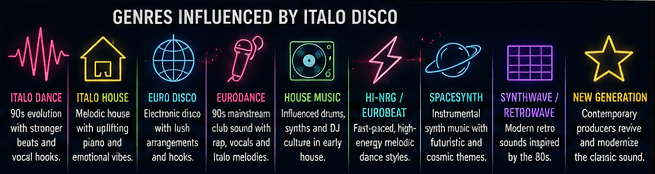
Italo Disco has influenced a wide range of electronic music styles, from 1980s Euro-based dance genres to modern retro-inspired productions. Its melodic synth sound and emotional character can still be heard in many contemporary styles.
- Italo Dance - A 1990s evolution with stronger beats, modern production and catchy vocal hooks, while keeping the melodic Italo spirit.
- Italo House - A fusion of house music and Italian melody, known for uplifting piano lines and euphoric club energy.
- Euro Disco - An earlier European disco evolution with electronic production, lush arrangements and strong melodic hooks.
- Eurodance - A 1990s mainstream club genre combining rap, vocals and high-energy Italo-style melodies.
- House music - Early European and Chicago house was influenced by Italo Disco through drum machines, synths and DJ culture.
- Hi-NRG / Eurobeat - Fast-paced, high-energy dance styles with driving basslines and melodic structures rooted in Italo Disco.
- Spacesynth - Instrumental, futuristic synth music inspired by cosmic themes and electronic soundscapes.
- Synthwave / Retrowave - Modern retro genres inspired by 1980s aesthetics and Italo Disco’s nostalgic synth sound.
- New Generation - Contemporary productions that revive and modernize classic Italo and Euro sounds for today’s audience.
Each of these genres developed from or was strongly influenced by the Italo Disco sound, either through its production style, melodic structure, or club culture evolution. You can explore a complete overview of all related styles on the genres overview page.
Final Thoughts
Italo Disco is more than just a nostalgic 80s genre - it is a sound that continues to resonate across generations. With its signature blend of melodic synthesizers, emotional vocals, and futuristic energy, it has secured a lasting place in the history of electronic music.
What started in Italian studios quickly spread across Europe, fueled by DJs, radio stations, and underground scenes, eventually growing into a global movement. Even today, its influence can be heard in modern electronic styles, retro-inspired productions, and DJ sets around the world.
At MixPerfect Radio, this legacy lives on through a continuous stream of classic tracks, rare gems, and modern productions - keeping the spirit of Italo Disco alive for both longtime fans and new listeners.
