
Italo Dance Radio: History, Sound & Culture Explained
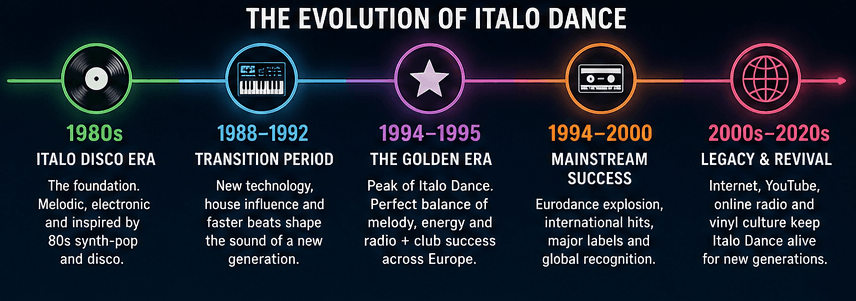
Italo Dance is a European electronic music style that emerged in the early 1990s as a natural evolution of Italo Disco. It was shaped by advances in synthesizer technology, changing club culture, and the rise of radio-driven dance music across Europe.
Built around melodic synthesis, emotional chord progressions, and club-oriented drum programming, the genre became a defining sound of the 90s European dance movement. Unlike minimal or underground techno scenes, Italo Dance was designed to be immediately accessible, combining radio-friendly structure with extended DJ club versions.
At its core, Italo Dance represents a fusion of commercial pop sensibility and underground club production techniques, making it one of the most influential foundations of modern European electronic dance music.
Today, Italo Dance Radio continues this tradition through online radio stations, 24/7 streaming platforms, and YouTube DJ mix archives, where classic 90s tracks are preserved and continuously rediscovered.
Quick Summary: Italo Dance Radio
- Origin: Early 1990s Italy, evolving from Italo Disco and influenced by Eurodance and house music.
- Golden Era: Peak popularity between 1994 - 1995 with strong radio airplay and club dominance across Europe.
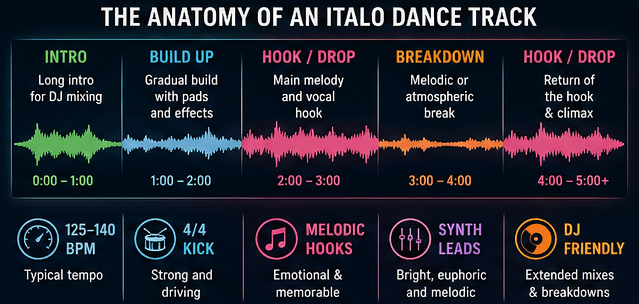
- Sound: Melodic synths, emotional chord progressions, 4/4 beats, and tempos between 125 - 140 BPM.
- Structure: Built for DJs with extended intros, breakdowns, and repetitive, mix-friendly arrangements.
- Key Artists: Gigi D’Agostino, Eiffel 65, Gabry Ponte, Alexia, Corona.
- Industry Model: Producer-driven scene with multiple aliases and fast-paced studio production.
- Distribution: Spread via radio, clubs, vinyl releases, and 90s compilation CDs.
- Modern Revival: Rediscovered through online radio, YouTube mixes, streaming platforms, and vinyl collectors.
- Today: A living digital subculture with 24/7 Italo Dance radio streams and global fan communities.
What is Italo Dance Radio?
Italo Dance Radio refers to online radio stations, streaming platforms, and DJ channels dedicated to Italo Dance, Eurodance, and related 90s Italian club music. These platforms act as digital archives of a genre originally shaped by club DJs, FM radio programming, and vinyl culture across Europe.
The focus is on extended mixes, rare vinyl pressings, promotional releases, and DJ edits that were rarely intended for commercial charts, but became essential in club culture.
In the 1990s, radio played a key role in breaking new club tracks. Many Italo Dance hits first gained popularity through heavy rotation on regional stations in Italy, Germany, and Central Europe, before spreading into clubs and charts.
Origins of Italo Dance
Italo Dance originated from the gradual decline of Italo Disco in the late 1980s and early 1990s. As the original Italo Disco wave faded, producers began evolving the sound by introducing stronger rhythmic structures, faster tempos, and more club-oriented arrangements influenced by the rise of house music, Eurodance, and the Belgian electronic scene.
This transition was not a sudden break, but a natural evolution driven by changing club culture and advances in music production technology. The emphasis shifted from melodic pop-influenced disco toward more energetic, DJ-friendly tracks designed for continuous mixing in clubs.
Italy quickly became the central creative hub of this transformation. Independent producers and small studio teams experimented extensively with synthesizers, drum machines, and early MIDI-based sequencing systems, allowing for faster production cycles and a more modular approach to songwriting.
Many early Italo Dance productions were created in tightly connected studio environments where the same producers, vocalists, and arrangers worked across multiple pseudonyms and projects, often releasing music simultaneously on different labels.
Influential Italian labels such as Media Records, Time Records, and SAIFAM Group played a key role in shaping this transition, providing the infrastructure for rapid production, distribution, and international export of the new dance sound.
By the early 1990s, this evolving style had fully separated from Italo Disco and established itself as a distinct genre: Italo Dance, characterized by its combination of emotional melody, club energy, and radio-friendly structure.
The Golden Era (1994 - 1995)
The years 1994 and 1995 are widely regarded as the golden peak of Italo Dance and Eurodance-influenced club music. During this period, the genre achieved its most refined balance between emotional melodic composition, driving club energy, and accessible radio structure.
This era represents the moment when Italian dance production reached full maturity. Studios had optimized fast production workflows, allowing tracks to be produced, released, and distributed at an unprecedented pace. The result was a constant flow of club anthems that dominated both radio playlists and European dancefloors.
European radio stations played a central role in amplifying this success. Tracks were not only popular in clubs but also received heavy rotation across Italy, Germany, Austria, Belgium, and Eastern Europe, creating a unified continental dance culture for the first time.
The sound of this era is often described as highly emotional yet highly functional: melodies were designed to be instantly recognizable, while arrangements were structured for DJs to mix seamlessly in extended sets.
Many of the most iconic releases from this period later became defining tracks of 90s nostalgia culture, influencing both modern electronic music production and contemporary revival scenes.
Production Style & Technology
Sound Characteristics
The signature sound of Italo Dance is built around emotional synthesis, rhythmic consistency, and strong melodic identity. Unlike minimal electronic genres, Italo Dance prioritizes harmonic progression and instant melodic recognition.
Iconic hardware played a key role in shaping this sound. Synthesizers such as the Roland JP-8000 became known for their “supersaw” leads, while the Korg M1 defined the classic piano sounds used in countless dance tracks. Drum machines like the Roland TR-909 provided the punchy kick drums and rhythmic foundation that drove club energy.
- Melodic synthesizer leads with emotional major/minor chord progressions
- Strong four-on-the-floor kick patterns (typically 125 - 140 BPM)
- Repetitive vocal hooks designed for instant memorability and radio accessibility
- Bright, euphoric harmonies with subtle melancholic undertones
- Simple but effective melodic structures optimized for looping
Production Structure & Arrangement
Beyond sound design, Italo Dance followed a highly functional arrangement philosophy tailored for DJs and radio formats.
- Extended intros designed for beatmatching in club environments
- Gradual build-ups leading into recognizable vocal or synth hooks
- Breakdowns creating emotional contrast before the drop returns
- Repetitive song cycles optimized for DJ sets and radio rotation
Studio Workflow & Technology
The genre was shaped by fast-paced studio workflows combining analog hardware with early digital production tools. Many tracks were produced in compact setups, enabling rapid iteration and high output across multiple aliases.
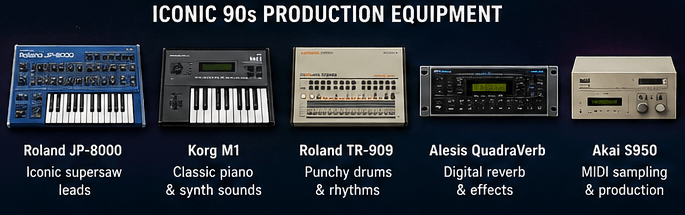
- Hardware synthesizers from Roland, Korg, and Yamaha
- MIDI-based sequencing for modular composition
- Layered synth stacking for dense, euphoric textures
- Early digital effects such as reverb, delay, and pitch modulation
A defining characteristic of the scene was the use of multiple pseudonyms by the same producers, creating a vast network of interconnected releases with shared production styles and recurring melodic themes.
Extended DJ mixes and instrumental versions were standard for most releases, reinforcing the genre’s dual focus on radio success and club functionality.
Key Artists of Italo Dance
The Italo Dance scene was not built around traditional bands, but rather a producer-driven ecosystem where DJs, producers, vocalists, and studio projects often overlapped under multiple aliases. Many artists functioned as creative projects rather than fixed musical groups, reflecting the fast-paced production culture of the era.
Pioneers and Defining Figures
Artists & Public Acts
Gigi D’Agostino - one of the most influential figures in Italian dance music, known for emotional minimalism and the development of Lento Violento- Prezioso feat. Marvin - “Tell Me Why”, “Let Me Stay”
- Da Blitz - “Let Me Be”, “Movin’ On”
- Ramirez - “La Musica Tremenda”, “El Gallinero”
- Taleesa - “Because the Night”, “I Found Luv”
- DJ Dado - “X-Files”, “Metropolis (The Legend of Babel)”
- Roland Brant - “Nuclear Sun”, “Mastermind”
- DJ Miko - “What's Up”, “Superboy”
- Cappella - “U Got 2 Let the Music”, “Move on Baby”, “U & Me”
- Gabry Ponte - “Geordie”, “Time to Rock”
- Benny Benassi - “Satisfaction”, “Able to Love”
- Floorfilla - “Anthem #2”, “Le Delire”
- Soundlovers - “Runaway”, “Walking”
- Neja - “Restless”, “Shock!”
- Kim Lukas - “All I Really Want”, “Let It Be the Night”
- Paps 'n' Skar - “Because I'm Free”, “Mon Amour”
Producers & Studio Architects
- Mauro Farina - key SAIFAM producer behind hundreds of Italo Dance, Eurodance and Eurobeat studio projects, shaping the industrial production model of Italian dance music
- Roberto Bortolotti - influential producer and songwriter involved in early Italian dance and Eurodance studio productions, contributing to the development of the Italo Dance sound system and production style
- Robyx (Roberto Zanetti) - producer behind major Eurodance acts and crossover hits, influential in bringing Italian dance music to global mainstream success
- Francesco Zappalà - early techno and dance producer bridging Italo Disco into modern club-oriented production
- DJ Dado - producer known for cinematic trance-influenced dance tracks connecting Italo Dance with early trance culture
Lento Violento: The Slower Evolution of Italo Dance
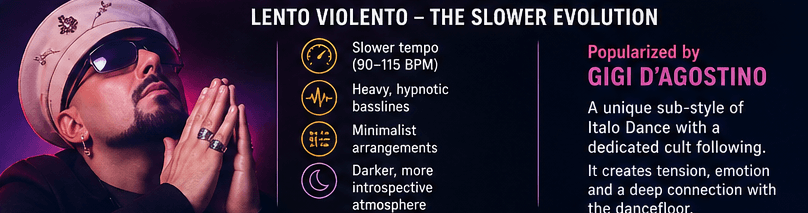
While most Italo Dance tracks are defined by energetic tempos between 125 and 140 BPM, a unique sub-style emerged in the late 1990s known as Lento Violento. Popularized by Gigi D’Agostino, this style slowed the tempo significantly while maintaining the emotional intensity and hypnotic structure of traditional Italo Dance.
Lento Violento is characterized by heavier basslines, minimalist arrangements, and a darker, more introspective atmosphere. Instead of fast-paced melodic progression, tracks focus on repetition, tension, and gradual evolution, creating a deep, almost trance-like experience on the dancefloor.
Despite its slower tempo, the genre retained strong rhythmic impact and club functionality. DJs used Lento Violento tracks to shift energy within sets, offering contrast to faster Eurodance and Italo Dance productions.
Although it never reached the same mainstream visibility as classic Italo Dance, Lento Violento developed a dedicated cult following, particularly in Italy and parts of Central Europe. Today, it remains an influential niche within the broader Italian electronic music scene.
Commercial Eurodance Crossovers
- Prezioso feat. Marvin - high-energy productions combining Eurodance structure with Italian melodic sensibility, becoming major club and radio hits across Europe in the late 90s and early 2000s
- Corona - internationally successful project known for iconic club anthems that dominated 90s dancefloors, blending Italo-influenced production with mainstream Eurodance appeal
- Alexia - one of the most important crossover vocalists, moving from Eurodance projects into a successful solo career with strong radio-oriented dance-pop productions
- La Bouche - German-based Eurodance act that heavily shared stylistic DNA with Italian dance productions, especially in vocal hooks and club arrangement structure
- 2 Unlimited - one of the biggest Eurodance acts of the era, whose high-energy structure and simple hook-driven approach strongly influenced Italo Dance radio-friendly production styles
- Black Box - Italian house/eurodance crossover project that bridged house music, Italo Dance aesthetics, and international pop success
- Snap! - influential Eurodance group blending rap, vocals, and club production, shaping the broader European dance sound that Italo Dance evolved alongside
Producer-Driven Culture
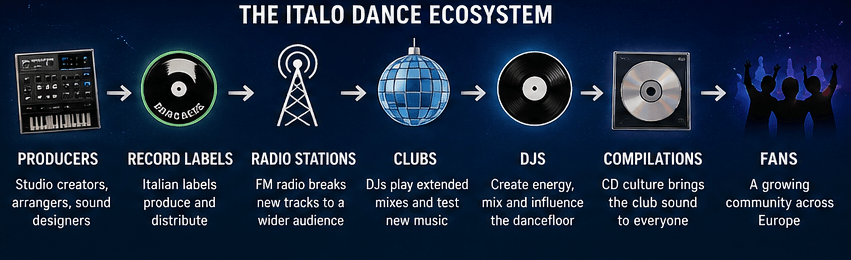
Unlike traditional pop acts, many Italo Dance “artists” were studio-based projects created by producers working behind the scenes. Vocalists were often session singers, while producers controlled multiple projects simultaneously under different names.
This structure allowed for rapid experimentation, high release frequency, and a continuous stream of club-oriented tracks across European labels. It also made the scene highly flexible, with the same production teams often working on dozens of different aliases and projects at the same time.
An important aspect of this evolution is that many producers and artists from the original Italo Disco era of the 1980s continued directly into the Italo Dance movement of the 1990s. Instead of disappearing, they adapted their sound by incorporating stronger beats, faster tempos, and house-influenced production techniques, effectively bridging the two genres.
This continuity meant that Italo Dance was not a completely new scene, but rather an evolution of existing Italian dance production culture. Studios, labels, and producers simply modernized their sound to match changing club trends and the rise of Eurodance and house music across Europe.
Compilations and CD Culture in the 90s
While club culture and radio played a major role in the rise of Italo Dance, the genre reached mainstream audiences primarily through compilation CDs. During the 1990s, these compilations became the dominant way for listeners to discover new dance music without needing access to clubs or vinyl records.
Instead of purchasing individual 12-inch releases, consumers could buy curated CD collections featuring the biggest club hits, radio edits, and emerging tracks from across Europe. These compilations acted as a bridge between underground club culture and everyday listeners, bringing the sound of the dancefloor directly into homes, cars, and portable CD players.
Iconic Compilation Series
- Hit Mania Dance - one of Italy’s most successful dance compilation series, featuring a mix of Italo Dance, Eurodance, and commercial club hits
- Dream Dance - widely popular across Germany and Central Europe, blending melodic dance, trance, and Italo-influenced productions
- Italo Fresh Hits - focused on showcasing the latest Italian dance releases and underground club tracks
- Radio Deejay Compilations - compilations and playlists associated with Radio Deejay, one of Italy’s most influential radio stations in shaping mainstream acceptance of Italo Dance, Eurodance, and club music culture
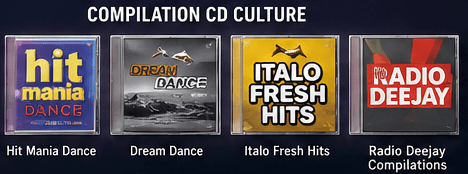
These compilation series were often released multiple times per year, reflecting the fast-paced production cycle of the dance music industry. Tracks could quickly gain popularity through inclusion on these CDs, sometimes even before achieving widespread radio or club success.
For many listeners, compilation albums defined the Italo Dance experience. They provided a curated snapshot of the evolving sound, combining commercial accessibility with club authenticity.
Today, these CDs are considered cultural artifacts of the 90s dance era, with collectors and enthusiasts preserving them as part of the broader history of European electronic music.
Record Labels & Producers
The success of Italo Dance was not only driven by individual artists, but by a powerful network of Italian record labels and production hubs. These labels functioned as creative factories, producing a constant flow of dance music under multiple aliases and project names.
Unlike traditional music industries, many Italian dance labels operated as integrated production ecosystems, where producers, arrangers, vocalists, and DJs worked closely together to create music specifically designed for club and radio circulation.
Major Italian Dance Labels
- Media Records - one of the most influential Italian dance powerhouses, responsible for shaping Eurodance exports and international club hits across Europe
- Time Records - a key bridge between Italo Disco, Eurodance, and Eurobeat, known for its massive influence on 90s club sound evolution and international distribution
- Bliss Corporation - global success story behind Eiffel 65, representing the commercial breakthrough of Italian dance music into worldwide pop charts
- SAIFAM Group - highly influential production hub operating as a “music factory,” responsible for hundreds of Eurodance, Italo Dance, and Eurobeat releases under countless project aliases
- Spy Records - underground-oriented label focused on energetic club releases and DJ-driven productions
The SAIFAM Production System
SAIFAM in particular became known for its industrial-scale production approach. Instead of focusing on individual artists, the label produced music as a continuous workflow system, often reusing melodic structures, production teams, and vocalists across multiple projects.
This approach allowed rapid output of club tracks and made SAIFAM one of the most prolific contributors to the European dance scene during the 90s and early 2000s.
Label Influence on the Sound
Each label developed a recognizable sonic identity. Media Records played an important role in the evolution of both Italo House and Eurodance, releasing early house-influenced club productions before shifting toward more polished Eurodance crossover hits in the 1990s. Time Records maintained a strong connection to Italo Disco roots and melodic dance structures, while SAIFAM emphasized high-output club functionality and Eurobeat-driven production.
Together, these labels formed the backbone of the Italian dance export industry that dominated European clubs and radio stations throughout the 1990s, bridging the transition from Italo Disco and Italo House into Italo Dance and Eurodance.
Radio Culture and Influential Stations
Radio played a fundamental role in the development and international success of Italo Dance. Unlike underground genres that relied primarily on clubs, Italo Dance was shaped equally by radio programming and DJ club culture.
Many tracks achieved popularity not through initial club exposure, but through repeated radio rotation, where radio DJs acted as gatekeepers who introduced new dance productions to a wider mainstream audience.
Influential Italian and European Stations
- Radio Deejay - one of Italy’s most influential stations, instrumental in promoting club music and introducing new Italo Dance releases to mainstream audiences
- Regional Italian FM stations - key drivers of early exposure for local dance productions before international distribution
- European dance radio networks - stations across Germany, Austria, Belgium, and Eastern Europe that heavily rotated Eurodance and Italo Dance tracks
Radio as a Bridge Between Clubs and Charts
Radio functioned as a critical bridge between underground club culture and commercial chart success. Tracks that performed well in clubs were often selected for radio edits, shortened arrangements, and remixed versions optimized for daytime listening.
This dual system - club versions versus radio versions - became a defining feature of the Italo Dance industry model.
Impact on Genre Growth
The heavy radio rotation across multiple European countries helped transform Italo Dance from a regional Italian phenomenon into a pan-European electronic music movement.
This widespread exposure also contributed to the genre’s golden era, where radio, clubs, and record labels operated in a tightly connected ecosystem.
DJ Culture and Mix Evolution
DJs played a central role in shaping the identity and global spread of Italo Dance. The genre was not only created for listening, but specifically designed for mixing in club environments, where DJs controlled the flow, energy, and emotional progression of entire nights.
Unlike purely radio-driven music, Italo Dance evolved through DJ interpretation. Tracks were often tested in clubs first, refined through audience response, and later adapted for radio release formats.
Vinyl and Club Distribution Culture
- 12-inch vinyl releases dominated club distribution, offering higher audio quality and extended playtime for DJ mixing
- Extended intros and breakdown sections were standard features, designed to facilitate seamless beatmatching and long transitions
- Promotional white-label releases circulated exclusively among DJs, often containing early or alternative versions of tracks
DJ Workflow and Mixing Philosophy
Italo Dance DJ sets were built around energy progression rather than track-by-track listening. DJs carefully structured sets using melodic buildup, emotional peaks, and rhythmic consistency to maintain dancefloor engagement.
The genre’s production style directly supported this approach, with many tracks engineered specifically to be “DJ-friendly” rather than purely radio-oriented.
Evolution Toward Modern Mixing Culture
As digital DJ technology emerged in the late 2000s and 2010s, Italo Dance experienced a second life in online mixes and digital sets. The same principles of extended transitions and melodic flow continued in modern DJ software environments.
Today, online radio streams and platforms preserve this DJ tradition by replicating continuous mix formats, blending classic vinyl-era tracks with modern reinterpretations of the genre.
Where Italo Dance Was Most Popular
Italo Dance developed into a pan-European phenomenon, but its success varied significantly by region. While Italy served as the production center, the genre often achieved its largest commercial impact abroad, where club infrastructure and radio support were particularly strong.
Key Regions and Cultural Impact
- Italy - the birthplace and production hub of Italo Dance, home to major labels, studios, and pioneering producers
- Germany & Austria - major club markets where Italo Dance was embraced in large-scale nightclub culture and DJ circuits
- Belgium & the Netherlands - early adopters of Eurodance and electronic dance music, providing strong radio and club support
- Eastern Europe - massive radio penetration and widespread popularity due to accessible melodic structure and strong emotional appeal
Why It Became More Popular Outside Italy
Interestingly, many Italo Dance tracks achieved greater success outside Italy than in their country of origin. This was largely due to differences in radio programming, club infrastructure, and audience demand across Europe.
In several foreign markets, especially Germany and Eastern Europe, the genre benefited from stronger club networks and higher demand for melodic electronic music, allowing Italo Dance to become a defining sound of 90s European nightlife culture.
A Truly European Sound
Over time, Italo Dance evolved from a national Italian movement into a fully European genre, shaped by cross-border exchange between DJs, radio stations, and record labels.
Collectors, Vinyl Culture & Rising Prices
Original 90s Italo Dance vinyl releases have become highly sought-after collector’s items within the global DJ and electronic music community. What was once standard club distribution material is now considered cultural archive material representing a key era in European dance history.
Rare pressings, promotional records, and limited editions often achieve significant resale value, especially when linked to influential labels, iconic club hits, or early production runs that were never widely reissued.
The growing demand is driven by a combination of nostalgia, analog sound quality, and DJ culture. Many collectors actively seek original pressings for their unique mastering characteristics and historical authenticity.
What Drives the Collectors Market
The rising value of Italo Dance vinyl is driven by a combination of nostalgia, scarcity, and audio authenticity. Original pressings are often preferred over digital remasters due to their distinct mastering characteristics and analog warmth.
DJs and collectors actively search for original releases because they offer both historical relevance and unique sound qualities that are difficult to fully replicate in modern digital formats.
Vinyl Culture in DJ Communities
Within DJ culture, owning original Italo Dance vinyl is often seen as a mark of authenticity and genre knowledge. Many classic tracks are still played in vinyl-only sets or re-edited for modern DJ performances, reinforcing the connection between past and present club culture.
Rising Value and Rarity
As demand increases and physical supply decreases, prices for certain Italo Dance records continue to rise. Limited pressings, white-label promos, and early label releases are particularly valuable due to their scarcity and historical importance.
Modern Revival & Internet Culture
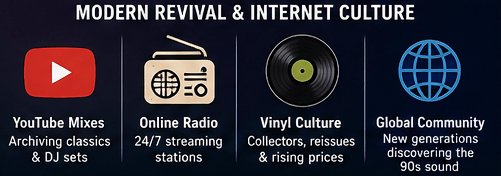
While Italo Dance reached its commercial peak in the 1990s and early 2000s, the genre has experienced a strong modern revival thanks to internet culture, streaming platforms, and global nostalgia for 90s electronic music. What was once a regional European club sound has now become a worldwide digital subculture.
From Clubs to Algorithms
In the early days, Italo Dance spread through radio stations and DJ sets in clubs across Italy and Europe. Today, discovery is driven by algorithms on platforms like YouTube, Spotify, Discogs, and social media. This shift has introduced the genre to new generations who never experienced the original club era.
YouTube Mix Culture and Archive Channels
YouTube has become one of the most important ecosystems for preserving Italo Dance history. Channels dedicated to continuous mixes, vinyl rips, live DJ sets, and nostalgic compilations have created a living archive of the genre.
One example is Zio Peter, who represents a wider community of DJs and uploaders keeping the sound alive through curated mixes and retro selections. His YouTube channel also includes 90allorah, a radio format where Italian producers and artists are regularly invited for interviews and guest appearances.
These kinds of channels function as modern digital radio stations, blending classic Italo Dance tracks with rare recordings, DJ mixes, and contemporary reflections from the original creators of the scene.
Digital Nostalgia and the 90s Revival Wave
The renewed interest in 90s culture has played a major role in the genre’s comeback. Social media platforms have amplified nostalgic aesthetics, from VHS-style visuals to retro club imagery, making Italo Dance part of a broader cultural revival of 90s electronic music.
This nostalgia wave has also influenced modern producers, who borrow melodic structures, synth sounds, and emotional progressions directly from the Italo Dance era.
Vinyl Reissues and Collector Communities
Alongside digital revival, there has been a strong resurgence in physical formats. Reissued vinyl releases, remastered compilations, and DJ-oriented pressings have brought classic tracks back into circulation.
Online collector communities actively trade original pressings, rare promos, and limited editions, often driving up prices for iconic 90s releases.
Streaming Platforms and Global Accessibility
Streaming services have made Italo Dance globally accessible for the first time. Curated playlists and algorithm-driven recommendations have introduced the genre to listeners in regions where it was never originally mainstream.
Modern Producers and Genre Influence
Contemporary electronic producers continue to draw inspiration from Italo Dance. Elements such as emotional chord progressions, euphoric synth layers, and simple vocal hooks can be found in modern EDM, trance, and even pop productions.
Online Radio and Continuous Streaming
Internet radio stations have become a modern extension of the original club and FM radio culture. 24/7 streams dedicated to Italo Dance recreate the feeling of continuous DJ sets, blending classic hits with modern reinterpretations.
Platforms like Radio Stad Den Haag, Fantasy Radio, Italo Dance FM, andMixPerfect Radio help preserve the genre’s identity while making it accessible to a global audience at any time of day.
Conclusion: A Living Digital Subculture
Today, Italo Dance is no longer just a historical genre from the 90s, but a living digital subculture. Through YouTube archives, online radio, vinyl collecting, and global nostalgia trends, the genre continues to evolve while staying deeply connected to its original identity.
Genres Influenced by Italo Dance
Italo Dance had a lasting impact on the development of multiple electronic music genres across Europe and beyond. Its focus on melody, emotional progression, and DJ-friendly structure influenced both underground and mainstream dance music scenes.
Directly Influenced Genres
- Eurodance - shared vocal-driven structure, catchy hooks, and radio-friendly production style that expanded on Italo Dance foundations
- Progressive House - adopted melodic layering, gradual build-ups, and emotional progression techniques
- Dream House - heavily influenced by the atmospheric and euphoric side of Italo Dance melodies
Later Electronic Evolution
- Trance - inherited harmonic progression structures and long-form breakdowns designed for emotional impact in clubs and festivals
- Modern EDM - uses simplified melodic hooks, festival-friendly arrangements, and drop-based structure inspired by late Italo Dance evolution
Long-Term Musical Influence
The influence of Italo Dance extends beyond direct genre lineage. Its production style helped establish a European approach to electronic music that prioritizes melody, emotional accessibility, and strong rhythmic clarity.
Many modern producers continue to draw inspiration from Italo Dance through synth design, chord progression techniques, and the balance between club functionality and radio appeal.
Italo Dance Radio Today
Modern Italo Dance radio stations continue the legacy of the genre through 24/7 streaming, curated DJ mixes, and carefully preserved archives of classic 90s club music. These platforms function as digital successors to the original FM radio culture that once defined the genre’s growth across Europe.
Today’s Italo Dance radio ecosystem combines original vinyl-era recordings with remastered tracks, rare promotional mixes, and modern productions inspired by the classic sound. This creates a continuous bridge between the golden era and the current revival wave of electronic dance music.
Digital Revival and Online Discovery
Unlike the 1990s, where radio and clubs were the primary discovery channels, modern audiences discover Italo Dance through streaming platforms, online radio, and algorithm-driven recommendations. This shift has introduced the genre to entirely new global audiences who never experienced the original club era.
MixPerfect Radio and Modern Streaming Culture
Platforms like MixPerfect Radio play an important role in preserving and evolving the genre by offering continuous streaming experiences that replicate traditional DJ set structures. These stations combine nostalgia-driven playlists with modern mixing techniques, keeping the spirit of Italo Dance alive in a digital environment.
A Living Genre
Today, Italo Dance is no longer just a historical genre, but a living and evolving part of online music culture. Through radio streams, DJ communities, vinyl collectors, and digital archives, the genre continues to influence both nostalgic listeners and new generations of electronic music fans.
Listen to Italo Dance Radio
Experience the full spectrum of Italo Dance 24/7 through curated radio streams, continuous DJ mixes, and timeless club anthems from the golden era of the 90s.
From rare vinyl recordings and classic radio edits to modern productions inspired by the original sound, Italo Dance Radio offers a nonstop journey through one of Europe’s most influential electronic music movements.
Whether rediscovering nostalgic classics or exploring the genre for the first time, listeners are immersed in a continuous flow of melodic, energetic, and emotionally driven dance music.
