
Eurobeat Radio: From Italo Disco to Japan’s High-Speed Dance Phenomenon
Eurobeat is one of popular music’s most fascinating cultural journeys. Its roots lie in the synthesizer-driven clubs and studios of 1980s Italy, but the style that listeners now recognise as Eurobeat was largely shaped by a market thousands of kilometres away. Italian writers, singers and producers made the records; Japanese labels, DJs, dancers and fans turned them into a long-running musical culture.
The result is instantly recognisable: a relentless four-on-the-floor beat, rapid octave bass lines, bright synthesizer brass, dramatic chord changes, exuberant vocals and a chorus designed to be remembered after a single listen. Later productions added distorted guitars, densely layered riffs and tempos that could make an already energetic Italo disco record sound almost relaxed by comparison.
Eurobeat is rarely heard on conventional FM radio today. Its natural home is specialist internet radio, music platforms and fan communities. Dedicated streams have included Eurobeat on laut.fm, Eurobeat Radio, and Super Eurobeat Radio on Jango, although online stations can change their schedules or disappear without warning. Broader dance stations occasionally include the style alongside Italo disco, Hi-NRG and Japanese dance music.
MixPerfect Radio takes a broader approach, playing Eurobeat alongside Italo Disco and other energetic European dance styles in a continuously generated non-stop mix. Its Eurobeat selection focuses mainly on the genre’s early period in the late 1980s and early 1990s, when the boundaries between Italo Disco, Hi-NRG and Eurobeat were still fluid.
Quick Summary: Eurobeat
- Origin: Eurobeat developed during the late 1980s and early 1990s from Italo Disco and Italian Hi-NRG. During this transitional period, Hi-NRG and Eurobeat were often overlapping terms for the same European dance records in Japan.
- Italian production: Most classic Eurobeat was written, performed and produced by Italian studio teams, often working through labels such as A-Beat-C, Time Records, Delta and Asia Records.
- Japanese market: Although primarily produced in Italy, the music was largely created for Japan, where record labels, compilation series, clubs and dancers shaped its development.
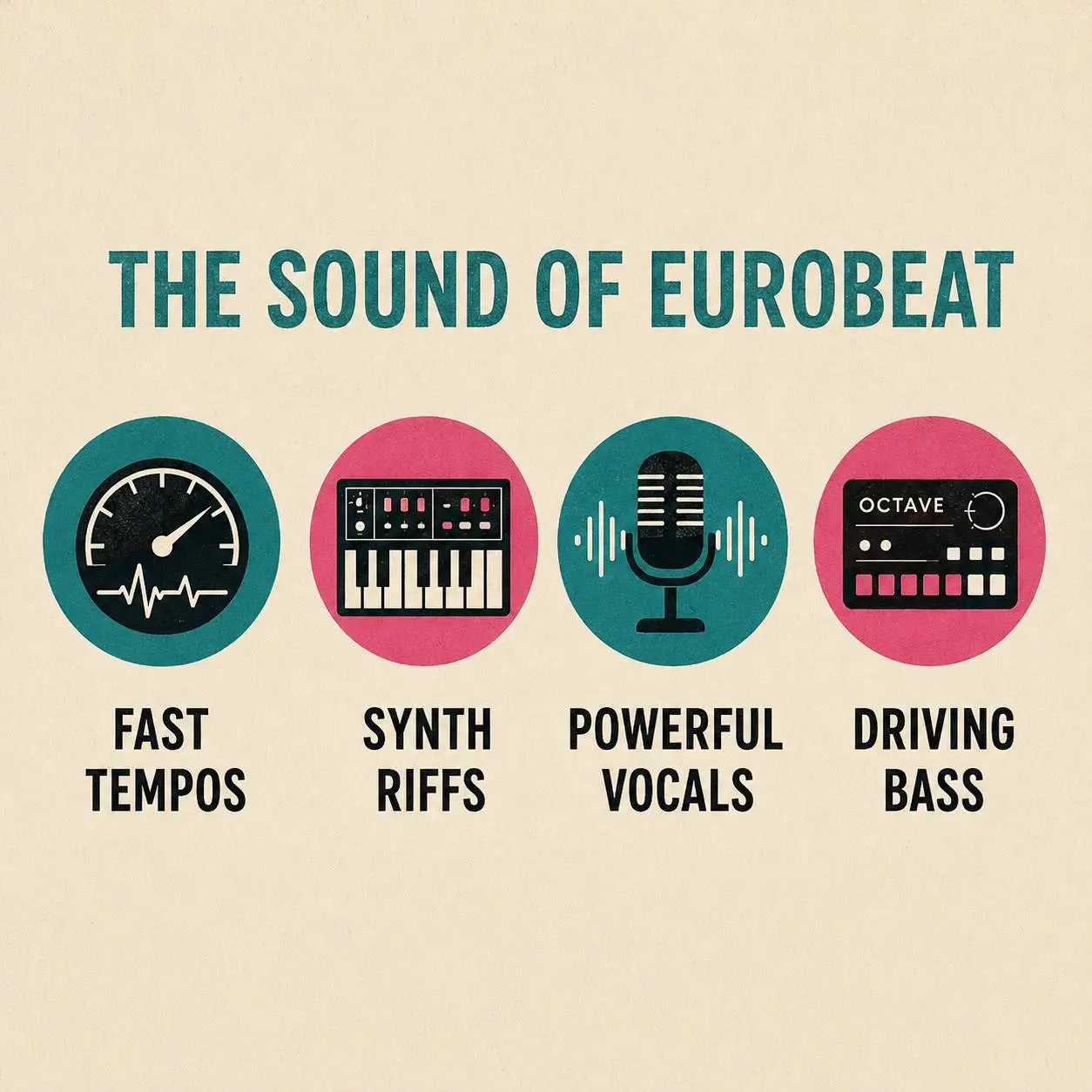
- Sound: The genre is known for fast four-on-the-floor rhythms, octave bass lines, dramatic vocals, bright synthesizers, powerful choruses and densely layered instrumental riffs.
- Evolution: Early releases remained close to Italo Disco and often ran at approximately 115 - 130 BPM. Later productions commonly reached 150 - 160 BPM or more, with harder drums, larger synth riffs and prominent electric guitars.
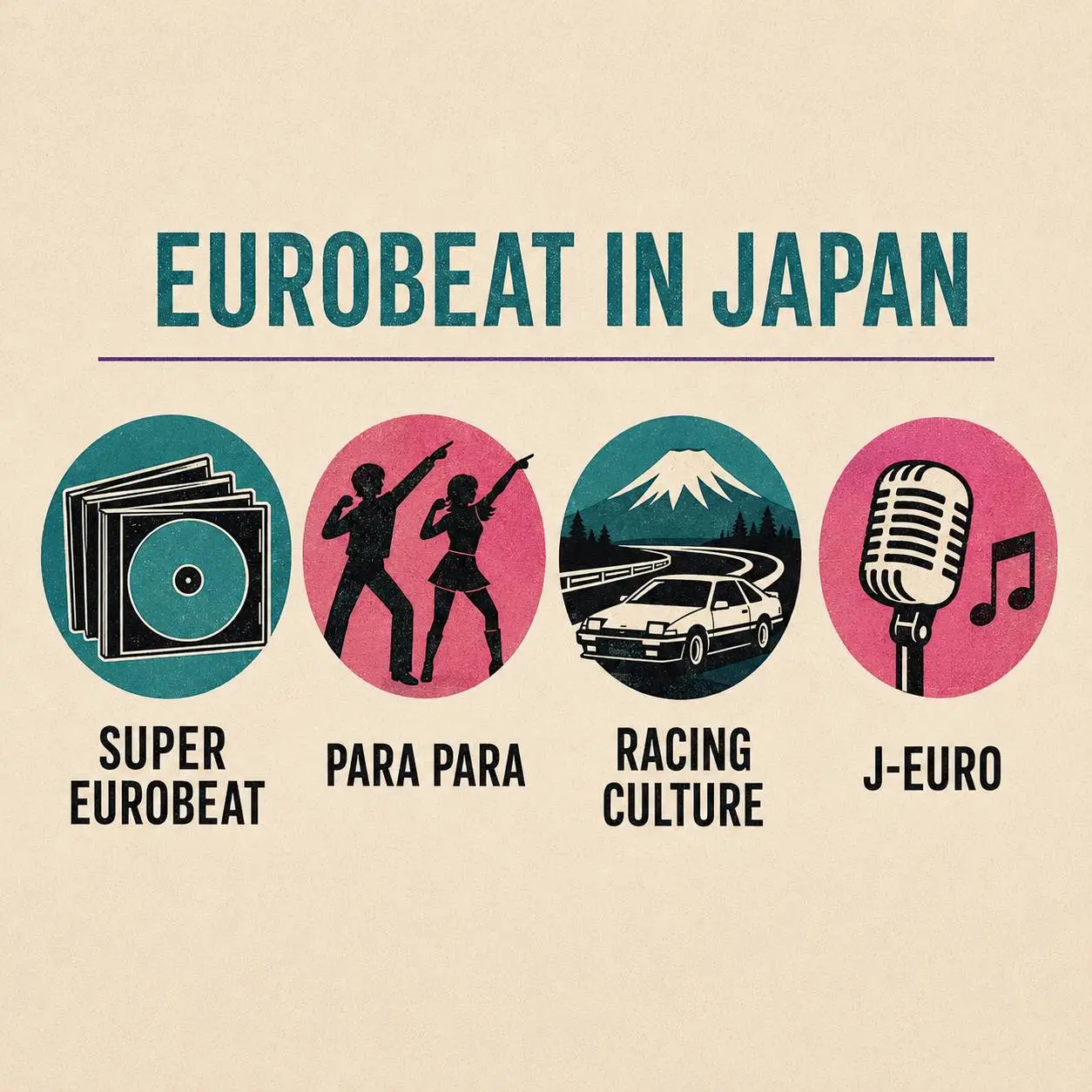
- Japanese culture: Eurobeat became closely associated with Para Para dancing, clubs such as Maharaja and velfarre, J-Euro, rhythm games and the street-racing anime series Initial D.
- Essential series: That’s Eurobeat helped establish the genre’s identity, while Super Eurobeat became one of the world’s longest-running music compilation series, reaching 250 numbered volumes by 2018.
- Today: Eurobeat continues through specialist events, online communities, streaming platforms and internet radio. MixPerfect Radio plays Eurobeat alongside Italo Disco and other energetic European dance styles in a continuously generated non-stop mix.
What does “Eurobeat” actually mean?
The name can be confusing because it has not always described the same music.
In the United Kingdom during the second half of the 1980s, “Eurobeat” was sometimes used for polished European-influenced dance-pop, including productions by Stock Aitken Waterman and records by artists such as Dead or Alive. That British use of the word largely disappeared as terms such as Eurodance and Euro house became more common.
In Japan, however, Eurobeat developed a much more specific meaning. At first it was a convenient name for imported European dance records - especially Italian Italo disco and Hi-NRG. It then came to describe a distinct, increasingly fast style made mainly by Italian studios for Japanese compilation albums, clubs and consumers. This article uses Eurobeat in that Japanese-market sense.
From Hi-NRG to Eurobeat
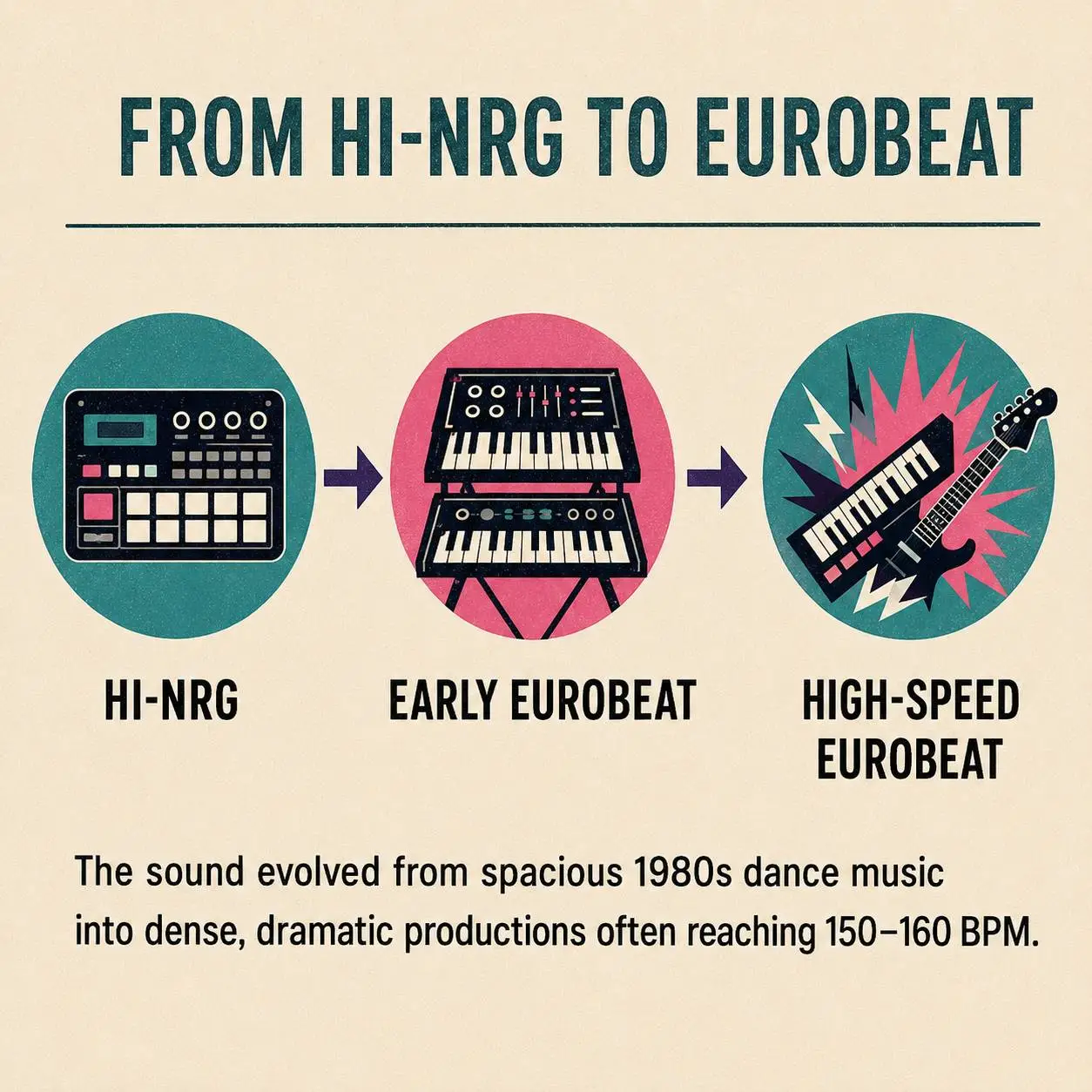
Between Italo Disco and the fully developed Japanese-market Eurobeat sound lies another important part of the story: Hi-NRG, pronounced “high energy.” The style emerged from disco and emphasised electronic production, a strong four-on-the-floor rhythm, sequenced octave bass lines, bright synthesizers and energetic vocals. These characteristics made it one of the clearest musical foundations of Eurobeat.
Hi-NRG was already faster and more forceful than much traditional disco, but many Italian Hi-NRG productions from the late 1980s and early 1990s still sound relatively restrained when compared with later Eurobeat. Tempos were generally lower, arrangements contained more space and the main synthesizer hooks were less densely layered. The music nevertheless contained many of the ingredients that Eurobeat producers would later exaggerate: rapid bass sequences, dramatic melodies, urgent choruses and an almost continuous sense of forward movement.
The distinction between Italo Disco, Hi-NRG and Eurobeat was not always clear at the time. During the late 1980s and early 1990s, Italian producers, Japanese record companies, DJs and compilation series frequently used Hi-NRG and Eurobeat for overlapping forms of European dance music. A recording described as Hi-NRG on one release could appear as Eurobeat on another, while early Japanese Eurobeat compilations contained music that modern listeners might classify as fast Italo Disco or Italian Hi-NRG.
Japanese compilation titles illustrate this overlap. Series such as That’s Eurobeat helped popularise the Eurobeat name, while Avex’s Maharaja Night - Hi-NRG Revolution used Hi-NRG terminology for music that increasingly resembled the developing Eurobeat style. In the early 1990s, the two names could therefore refer to much of the same Italian-produced club repertoire.
As the 1990s progressed, Eurobeat acquired a more distinct identity. Tempos moved further into the 140 - 160 BPM range, drums became harder, choruses more explosive and the instrumental sabi developed into a densely layered signature riff. At that point, Eurobeat was no longer merely another name for Italian Hi-NRG: it had become a specialised genre shaped around the demands of the Japanese market.
From Italo disco to early Eurobeat
Eurobeat did not suddenly replace Italo Disco or Hi-NRG. It emerged gradually from both styles, carrying their production methods and musical vocabulary into a faster and increasingly specialised form.
Classic Italo disco relied heavily on electronic instruments, sequenced bass lines, drum machines, catchy melodies and romantic English-language lyrics. Many records were made by small teams in modest Italian studios. The credited “artist” was often a studio project rather than a permanent performing act. One singer could therefore appear under several names, while a single name could sometimes be passed from one vocalist to another.
During the mid-to-late 1980s, Japanese buyers developed a strong appetite for these imports. Italian producers discovered that records which had limited prospects in a changing European market could be highly desirable in Japan. Japanese companies began licensing material directly, and some music was soon written specifically with Japanese clubs and compilation buyers in mind.
Mauro Farina and Giuliano Crivellente’s production network was central to this transition. Their music, issued through companies and labels associated with SAIFAM and Asia Records, supplied much of Alfa International’s influential That’s Eurobeat series. The series helped establish “Eurobeat” as a marketable name in Japan while the music itself still sounded close to fast Italo disco and Hi-NRG.
Early Eurobeat was generally slower and less overloaded than the style of the late 1990s and 2000s. Tempos commonly sat in roughly the 115 - 130 BPM area, although there were exceptions. Arrangements had more space, bass lines retained a strong Italo character and synthesizer riffs were comparatively simple. The mood could be romantic, mysterious or melancholic as well as celebratory.
As Japanese demand grew, producers intensified the formula. Tempos rose through the 130s and 140s; by the genre’s mature period, tracks around 150 - 160 BPM were normal, with some moving even faster. The percussion became harder, vocal delivery more urgent and the signature instrumental hook - often called the sabi in Eurobeat circles - became larger and more complex. Later riffs might combine numerous layers of brass-like synthesizers, leads, orchestral hits and guitars.
Music made in Italy for Japan
The phrase “made by Italians for the Japanese” is a useful summary, although it should not be treated as an absolute rule. There were singers and contributors from other countries, Japanese Eurobeat productions eventually emerged, and Italian labels also sold records elsewhere. Nevertheless, the classic production chain was remarkably consistent:
- An Italian production team wrote, arranged and recorded a song in English.
- The track was assigned to a marketable artist name, frequently an alias.
- An Italian label or production company supplied it to a Japanese licensee.
- A Japanese compilation series introduced it to clubs, dancers and record buyers.
- Extended versions, radio edits and non-stop mixes gave the same recording several lives.
Japanese demand did more than keep an Italian style alive. Feedback from labels, DJs and audiences affected tempos, arrangements, themes and even song titles. References to speed, fire, night, dancing, Japan, fantasy and cars became dependable parts of the vocabulary. Eurobeat was therefore not simply European music exported unchanged: it was a transnational product refined through a long exchange between Italian studios and Japanese popular culture.
The Japanese compilations that defined the genre
In a genre built around studio projects rather than conventional albums, compilations functioned almost like the main historical record.
That’s Eurobeat
Released in Japan by Alfa International, That’s Eurobeat was one of the key bridges between Italo disco, Hi-NRG and the emerging Eurobeat identity. It drew heavily on the prolific Farina - Crivellente circle and music from Asia Records and related operations. Its late-1980s volumes document the point at which the Japanese term “Eurobeat” still covered material that modern listeners might classify as Italo disco or Hi-NRG.
Super Eurobeat
Super Eurobeat, usually abbreviated to SEB, became the genre’s most important compilation brand. The first eight volumes appeared through Beat Freak in 1990. Avex took over the series from Volume 9 and made it one of the foundations of the young company’s dance-music identity.
Running from 1990 to its 250th numbered volume in 2018, Super Eurobeat became one of the longest-running music compilation series in the world. For much of its history, new volumes appeared at an unusually rapid pace - initially monthly and later less frequently - creating a continuous demand for new songs from Italian production teams. The regular numbered series ended with Volume 250, although Avex continued the brand through annual The Best of Super Eurobeat releases. Few compilation series have documented the development of a single dance genre so extensively or for such a long period.
SEB connected Japanese listeners with Italian labels and production houses including A-Beat-C, Time Records, Delta and many others. It introduced generations of new songs, artist aliases and variations on the Eurobeat sound. Anniversary editions, request countdowns and non-stop mixes also helped establish a shared musical canon.
Maharaja Night and Hi-NRG Revolution
Avex’s Maharaja Night - Hi-NRG Revolution releases were closely connected to the Maharaja discotheque culture. The series featured many records that became Eurobeat standards and reinforced the relationship between imported Italian music and Japanese club life.
Other important Japanese series and labels
Japan also received Eurobeat through series such as Eurobeat Flash, Euromach, ParaPara Paradise, The Early Days of SEB, and numerous Initial D collections. Toshiba-EMI’s wider Dancemania family concentrated on several forms of international dance music rather than Eurobeat alone, but its compilations and rhythm-game connections helped familiarise Japanese audiences with fast European dance styles.
The most important Japanese companies in this story include Alfa International, Beat Freak and especially Avex Trax. They were not merely passive distributors: their compilations, marketing, club relationships and licensing decisions shaped what Eurobeat became.
Eurobeat on Japanese radio
Despite Eurobeat’s enormous influence in Japan, it was never primarily a conventional radio genre. Its success was driven more strongly by imported records, compilation CDs, discotheques, Para Para events, anime and arcade games. Mainstream Japanese radio stations occasionally played popular Eurobeat and J-Euro releases, but dedicated long-running terrestrial Eurobeat stations appear to have been rare.
There have nevertheless been specialist radio programmes. In early 2025, FM AICHI broadcast MINI Toyohashi presents Eurobeat Memories, a weekly programme built around Eurobeat songs and memories submitted by listeners. The programme demonstrated that the genre still had sufficient cultural recognition in Japan to support a dedicated show on conventional regional FM radio, even decades after its commercial peak.
Japan has also produced dedicated online radio projects. In January 2021, Avex launched HI-BPM STUDIO 24/7 Live Radio through its official Eurobeat YouTube channel. The continuous stream presented Eurobeat music alongside footage from the Initial D anime franchise. It was both an online radio service and an extension of the Super Eurobeat brand, introducing the catalogue to listeners who had discovered the genre through anime, games and internet culture.
These examples reflect Eurobeat’s unusual media history in Japan. Rather than depending on constant mainstream radio exposure, the genre built its audience through compilations, clubs and visual culture. Specialist broadcasts and online streams later helped preserve that connection and made the music accessible to new generations.
The Italian labels and production houses
The boundary between label, publisher, studio and production team is not always neat in Eurobeat history. Nevertheless, several names are indispensable.
A-Beat-C
Founded around the creative partnership of Giancarlo Pasquini (Dave Rodgers) and Alberto Contini, A-Beat-C was crucial in defining the 1990s sound. Its productions combined strong pop songwriting with rising tempos, powerful riffs and, increasingly, rock guitar. The label supplied a large amount of material to Super Eurobeat and introduced enduring acts such as Dave Rodgers, Domino, Powerful T. and Mega NRG Man.
Time Records
Time Records, founded by Giacomo Maiolini, was already an important Italo disco label before becoming a major Eurobeat supplier. Producers and writers connected with Time included Laurent Gelmetti - better known as Laurent G. Newfield - and Andrea Leonardi, later widely known as Bratt Sinclaire. Time’s catalogue ranges from transitional late-Italo records to some of the best-known high-speed Eurobeat productions.
SAIFAM and Asia Records
The enormous production network built by Mauro Farina and Giuliano Crivellente operated through SAIFAM and labels including Asia Records. It generated a vast catalogue for the Japanese market and was fundamental to That’s Eurobeat. Farina was not only a producer and writer but also one of the genre’s most prolific male vocalists.
Delta
Delta was established by Laurent G. Newfield, Bratt Sinclaire and singer-songwriter Clara Moroni after their work within the Time orbit. Its mid-to-late-1990s catalogue pushed Eurobeat toward a harder, faster and more dramatic sound. Delta releases often combined aggressive production with exceptionally strong vocal performances.
Hi-NRG Attack
Hi-NRG Attack embraced Eurobeat’s most colourful and exaggerated tendencies. Associated with the “Franz Tornado” persona and later closely linked to Bratt Sinclaire’s production work, the label became famous for frantic tempos, comic concepts, unusual vocal effects and titles that celebrated food, animals, machines and absurd characters as readily as romance.
SCP Music
Producer Stefano Castagna established SCP Music, which supplied a polished new generation of Eurobeat. SCP became particularly associated with vocalists and projects such as Fastway, Ace and Go Go Girls. Its records retained the classic verse - bridge - chorus formula while using cleaner digital production and dense, modern arrangements.
Other notable Italian names
The wider network also included Flea Records, Discomagic, Boom Boom Beat, Vibration, LED Records, Energy Revolution, DMI (Delta Music Industry), SinclaireStyle, and Dave Rodgers’ later Dave Rodgers Music. Catalogue ownership and personnel changed over time, so these names represent overlapping generations rather than isolated schools.
Producers who shaped the sound
Mauro Farina and Giuliano Crivellente helped turn the speed and directness of Hi-NRG and Italo disco into an industrially productive Japanese-market format. Their team could create an extraordinary number of songs while maintaining memorable melodies and a recognisable sound.
Giancarlo Pasquini (Dave Rodgers) was a songwriter, singer, musician, producer and label founder. His A-Beat-C work established many of the genre’s central conventions, while his later visibility through Initial D made him perhaps the best-known individual in Eurobeat.
Alberto Contini combined technical, writing and business roles at A-Beat-C. His contribution is sometimes overshadowed by the public Dave Rodgers persona, but he was an essential part of the label’s identity.
Laurent G. Newfield (Laurent Gelmetti) was a prolific writer, arranger and producer whose work for Time and Delta helped move the music from late-1980s Hi-NRG toward the sharply articulated 1990s style.
Bratt Sinclaire (Andrea Leonardi) became one of Eurobeat’s most distinctive producers. His productions are often immediately identifiable through their muscular rhythm sections, elaborate synth riffs and dramatic sense of momentum. His credits encompass many major songs and several label eras.
Stefano Castagna brought detailed digital production and powerful vocal recording to SCP Music. His work helped Eurobeat remain recognisable and competitive after the style’s main commercial peak.
Other important creators include Sandro Oliva, Luigi Raimondi, Andrea Delfino, Sergio Dall’Ora, Luca Pernici, Gino Caria, Accatino and Rimonti, and numerous engineers, guitarists, backing singers and lyricists whose names were less visible than the aliases on the covers.
Famous Eurobeat artists and essential songs
Calling these “artists” requires one qualification: many were studio identities. The descriptions below therefore refer to the recording persona, while the next section identifies some of the singers behind the names.
Dave Rodgers
The best-known Eurobeat figure is the main stage identity of Giancarlo Pasquini. His records combine heroic vocals, pop melody, guitar and an unmistakable fascination with speed and motion. Initial D introduced several of them to a worldwide audience.
Essential songs:
- “Deja Vu”
- “Space Boy”
- “Beat of the Rising Sun”
- “Boom Boom Japan”
- “Kingdom of Rock”
Domino
Domino, most famously voiced by Alessandra Mirka Gatti, represents Eurobeat’s playful and commanding female side. The act’s records range from melodic club songs to exuberant novelty concepts, usually delivered with great precision.
Essential songs:
- “Tora Tora Tora”
- “In the Heat of the Night”
- “Para Para”
- “Popteen”
- “Mickey Mouse March”
Mega NRG Man
Primarily associated with vocalist Tomas Marin, Mega NRG Man became an A-Beat-C emblem. The project’s songs are robust, theatrical and ideal for the genre’s combination of dancefloor power and automotive imagery.
Essential songs:
- “Seventies”
- “Back on the Rocks”
- “Express Love”
- “Get Me Power”
- “Burning Desire”
Niko
Niko is one of the prominent identities used by Maurizio De Jorio. His gritty, forceful vocal style gave “Night of Fire” the intensity needed to become a Para Para and Initial D classic.
Essential songs:
- “Night of Fire”
- “Made of Fire”
- “Speedway”
- “Superbad”
- “Electric Power”
Max Coveri
The Max Coveri name has been connected with more than one singer, but its best-known later recordings are associated with Maurizio De Jorio. “Running in the 90’s” escaped the specialist scene through Initial D and internet culture.
Essential songs:
- “Running in the 90’s”
- “Golden Age”
- “I Don’t Wanna Break Your Sweet Heart”
- “High Desire”
- “Like a Thunder”
Leslie Parrish
Voiced by Clara Moroni, Leslie Parrish combines vocal power with emotional material. These recordings demonstrate that Eurobeat can be dramatic and bittersweet even at very high speed.
Essential songs:
- “Remember Me”
- “Killing My Love”
- “Save Me”
- “Heart of Stone”
- “Mon Amour”
Virginelle
Virginelle, closely associated with Elena Ferretti, is one of the classic female identities of the transitional and mature periods. The songs often balance romantic longing with bright, propulsive arrangements.
Essential songs:
- “Fantasy”
- “Hot Love & Emotion”
- “Like a Virgin”
- “Tango Tango”
- “Lucky Lucky”
Lolita
Lolita became one of Eurobeat’s most durable female projects, generally associated with Elena Gobbi. Its catalogue ranges from sweet melodic material to faster, assertive later productions.
Essential songs:
- “Try Me”
- “Everybody Dance”
- “Love & Money”
- “Walkie Talkie”
- “You’re Gonna Be”
Go Go Girls
Go Go Girls is a female group identity rather than a conventional touring band. Its records are built for communal energy, with bold harmonies and choruses that fit Para Para routines particularly well.
Essential songs:
- “One Night in Arabia”
- “Dance Around the World”
- “Speedy Speedy”
- “Go Go Dance”
- “The Melody Is in Your Heart”
Fastway
Fastway is one of Ennio Zanini’s principal identities. It represents the rock-oriented edge of 2000s Eurobeat, combining bright synth hooks with aggressive male vocals and guitar energy.
Essential songs:
- “Rockin’ Hardcore”
- “Revolution”
- “Go Beat Crazy”
- “Spacelove”
- “Number One”
Manuel
Manuel is voiced by Manuel Caramori. The project reached a global online audience with the explosive “Gas Gas Gas,” but its catalogue contains many equally energetic productions.
Essential songs:
- “Gas Gas Gas”
- “Limousine”
- “Let’s Go, Come On”
- “On My Wings”
- “No Control”
Powerful T.
Powerful T., performed by rock singer Roberto Tiranti, illustrates the technical standard of the genre’s best vocalists. His range and controlled intensity allow the arrangements to approach melodic metal without ceasing to be dance music.
Essential songs:
- “Over the Rainbow”
- “Fight for Your Empire”
- “Maximum Power”
- “7 Laps to Go”
- “Into the Game”
Ace
Usually associated with Christian Codenotti, Ace belongs to Eurobeat’s later generation. The project combines polished production, youthful vocals and themes of motion, emotion and competition.
Essential songs:
- “Crazy on Emotion”
- “Adrenaline”
- “Power of Sound”
- “Rider of the Sky”
- “Futureland”
Ken Blast
Ken Blast is an alias of American vocalist Jessa Stebbins, demonstrating that the studio network was not exclusively Italian. “The Top,” used in Initial D, became the project’s defining recording.
Essential songs:
- “The Top”
- “When the Sun Goes Down”
- “New Horizon”
m.o.v.e and Japanese performers
Japan also developed acts that incorporated Eurobeat into J-pop, rap and electronic music. m.o.v.e, featuring vocalist Yuri Masuda and rapper motsu, became inseparable from Initial D through songs such as “Around the World,” “Rage Your Dream,” “Gamble Rumble” and “Dogfight.” Artists including MAX, Namie Amuro, V6, Dream, Every Little Thing and Ayumi Hamasaki recorded Japanese covers or released Eurobeat remix projects, forming the broad category known as J-Euro.
The singers behind hundreds of imaginary stars
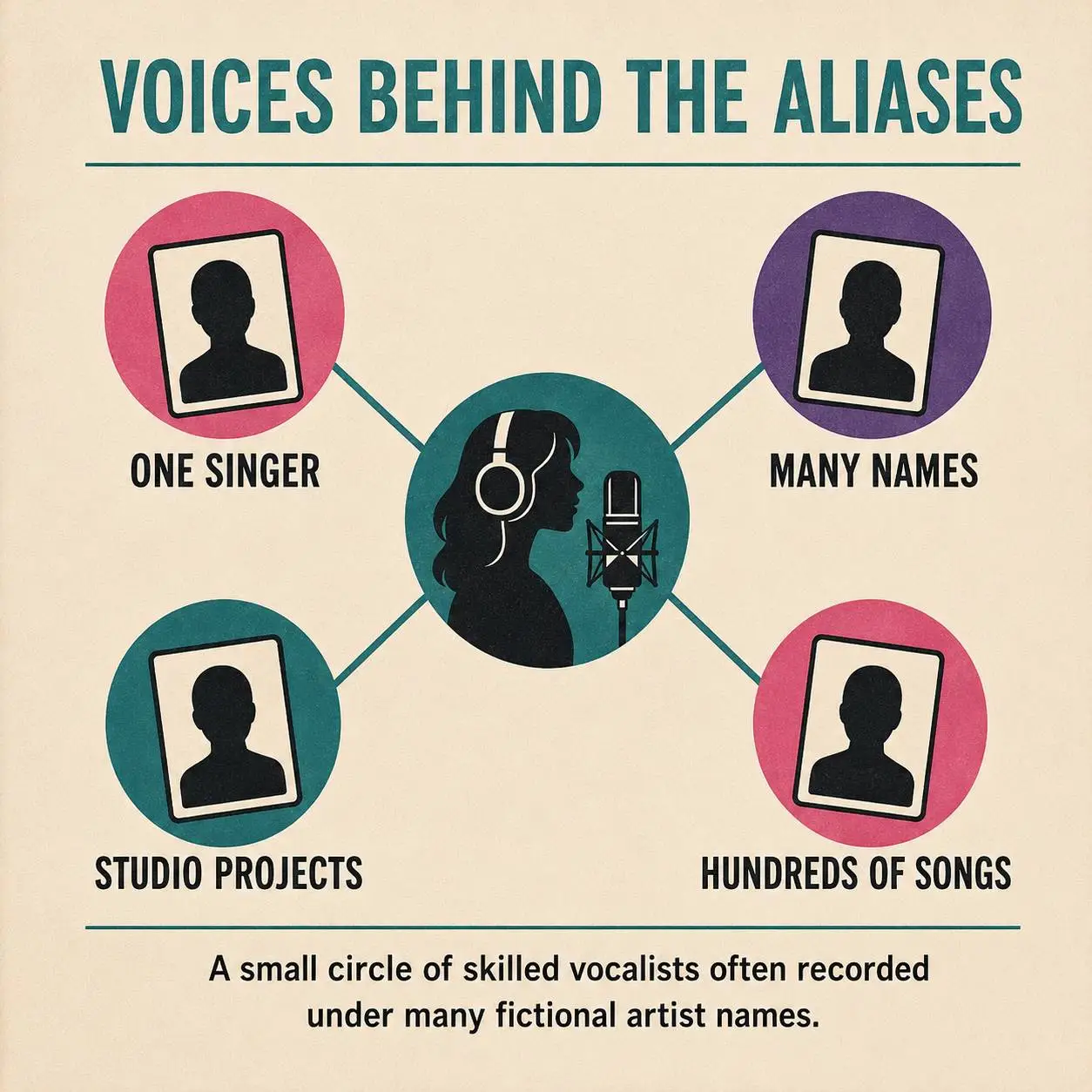
Eurobeat’s system of aliases was inherited from Italo disco. It allowed labels to present a compilation with many apparent acts even when a relatively small circle of vocalists had performed the songs. Aliases could also separate moods: one singer might use one name for romantic material and another for comic or aggressive songs.
The credits are complicated. An alias could be shared by several singers over time, and old releases did not always identify the vocalist. The following associations are therefore representative rather than exhaustive:
- Mauro Farina sang an enormous number of records under names including Mark Farina and numerous SAIFAM/Asia studio identities. He was simultaneously a singer, writer and producer.
- Giancarlo Pasquini was heard as Dave Rodgers and under identities such as The Big Brother, Robert Stone, Derek Simon and others across his long career.
- Maurizio De Jorio supplied the voice of Niko, Marko Polo and many Max Coveri-era tracks, as well as projects including D. Essex and Morris.
- Gino Caria was a major early male vocalist and writer, associated with projects such as K.L. Jones, Robert Stone recordings and several Time-era identities before his death in 1997.
- Clara Moroni recorded as Leslie Parrish, Vicky Vale, Cherry and additional aliases. Her combination of strength, range and emotional clarity made her one of Eurobeat’s defining voices.
- Alessandra Mirka Gatti is best known as Domino and was also heard under names including Lolita-era or A-Beat-C-related identities depending on the production period; she later became a producer and label operator herself.
- Elena Ferretti voiced Virginelle and numerous other Italo/Eurobeat projects, including Sophie and Rose identities in parts of the wider catalogue.
- Elena Gobbi is strongly associated with Lolita and contributed to Go Go Girls and other female projects.
- Annerley Gordon recorded Eurobeat and Italo material both under variants of her own name and under multiple project names before becoming internationally known as the uncredited original studio voice connected with several Italian dance productions.
- Fernando Bonini sang under many energetic male aliases, including Dr. Love and Mr. Groove.
- Ennio Zanini is the voice behind Fastway and Dusty, two names that help distinguish his standard Eurobeat and more rock-oriented material.
- Roberto Tiranti, best known in rock and metal circles, brought a technically accomplished voice to Powerful T. and other projects.
The alias system can frustrate discographers, but it is part of Eurobeat’s character. Its “stars” are simultaneously fictional pop characters and the work of a close-knit professional studio community.
How a Eurobeat record is built
A mature Eurobeat arrangement often opens with a preview of its main hook before moving into the verse. The harmony then rises through a pre-chorus or bridge, creating tension, and releases into a large chorus. After the chorus comes the signature synth riff - the instrumental payoff commonly called the sabi. Variations of verse, bridge, chorus and riff return with added backing vocals, fills and countermelodies.
Several recurring musical devices create the sense of constant acceleration:
- Four-on-the-floor kick drum and sharply gated or clapping snares
- Rapid offbeat hi-hats and busy fills
- Sequenced octave bass, inherited from disco and Hi-NRG
- Chord progressions that rise or modulate toward the chorus
- Layered brass-like synth stabs and lead lines
- Short vocal commands, shouts and call-and-response backing parts
- Distorted rhythm or lead guitar in many later productions
- Sudden breaks that make the return of the beat feel even faster
Extended mixes commonly begin and end with percussion and instrumental passages for DJs. Japanese compilations often used shorter edits or non-stop mixes, so collectors may encounter substantially different versions of the same song.
Synthesizers, drum machines and studio equipment
There was no single official Eurobeat setup. Different studios used different equipment, and the genre spans the transition from analogue synthesis and tape to MIDI sequencing, digital workstations, sampling and computer-based recording. Nevertheless, several families of instruments are characteristic of the periods from which Eurobeat emerged.
Early Italo disco and Hi-NRG studios commonly used analogue and early digital synthesizers such as the Roland Jupiter and Juno series, Oberheim polyphonic synths, Sequential Circuits Prophet models and the hugely successful Yamaha DX7. Drum parts could come from machines including the LinnDrum, Oberheim DMX, Roland TR series and E-mu Drumulator, sometimes reinforced or replaced with sampled sounds.
As Eurobeat developed, studios increasingly relied on MIDI and digital instruments. The Atari ST became a popular sequencing computer in European studios because of its built-in MIDI ports, often running software such as Cubase or Notator. Akai S-series samplers made it practical to trigger vocal fragments, drums, orchestral hits and custom effects. Digital synthesizers and workstations such as the Roland D-50, JD and JV series, Korg M1 and Wavestation, Yamaha SY/TG series, E-mu Proteus modules and Kurzweil workstations offered the bright brass, pianos, strings and layered textures demanded by increasingly dense arrangements.
Producers rarely depended on untouched factory presets alone. Sounds were layered, detuned, filtered, sampled and processed to produce the gigantic Eurobeat riff. Hardware mixers, compressors, gates, digital delays and reverbs helped turn many separate parts into a single wall of motion. Later studios moved toward computer recording and software instruments while retaining the musical vocabulary established by the older equipment.
Electric guitar became particularly important from the mid-1990s onward. It could double a synth riff, add palm-muted rhythm, or provide a spectacular solo. Jennifer Batten - known internationally for her work with Michael Jackson and Jeff Beck - contributed guitar and composition to A-Beat-C productions, illustrating how ambitious the studio craft could be beneath Eurobeat’s colourful surface.
What are Eurobeat lyrics about?
Eurobeat lyrics are designed first for immediacy, emotion and rhythmic impact. Because many were written in English by Italian writers for Japanese listeners, naturalistic English was not always the main priority. Unusual phrases are part of the style’s charm, but the best lyrics use simple vocabulary very effectively.
Common subjects include:
- Love and desire: urgent attraction, heartbreak, jealousy and reconciliation
- Nightlife: dancing, discos, DJs, music and losing control
- Speed and driving: engines, highways, racing, danger and freedom
- Fire and heat: recurring metaphors for passion and energy
- Power and self-belief: fighting, winning and refusing to surrender
- Fantasy and escape: dreams, stars, magic and distant worlds
- Japan itself: Tokyo, Japanese imagery and direct tributes to the audience
- Comic novelty: food, animals, technology and intentionally absurd characters
The lyrics often address the listener directly - “come on,” “take me,” “feel it,” “don’t stop” - which makes them effective in clubs and synchronised dance routines. Titles favour short, vivid phrases because a memorable concept had to stand out on a compilation containing many unfamiliar artist names.
Para Para: Eurobeat becomes a social dance
Eurobeat’s Japanese history cannot be separated from Para Para. Unlike partner dancing or improvised club styles, Para Para uses synchronised routines dominated by coordinated arm and hand movements, with comparatively simple steps. Groups of dancers perform the same choreography together, turning each record into a shared physical language.
Early forms developed in Japanese disco culture during the 1980s, while later Eurobeat booms made the dance much more visible. Clubs, instructors and commercial videos distributed official or widely accepted routines. A song could gain extra life because dancers learned its choreography; equally, a strong Para Para routine could help make a song memorable.
The Maharaja clubs and later venues such as velfarre became symbols of the culture. Para Para experienced several waves rather than one uninterrupted craze. Fashion, club economics and generational changes caused interest to rise and fall, but organised events and online video have preserved the routines. The dance also explains some of Eurobeat’s musical consistency: a stable beat, clear sections and dramatic cues are valuable when many people must move together.
Initial D, cars and global rediscovery
Shuichi Shigeno’s street-racing manga Initial D, its anime adaptation and its arcade games transformed Eurobeat’s international image. Songs such as “Space Boy,” “Night of Fire,” “Running in the 90’s,” “Remember Me” and “Deja Vu” accompanied mountain-pass races with such effectiveness that the music became inseparable from drifting and Japanese car culture.
Initial D did not create Eurobeat and should not be mistaken for the full genre. Much of the catalogue concerns romance, dancing or fantasy rather than cars. Yet the franchise gave listeners outside Japan an accessible route into a musical culture whose original CDs were often expensive imports. Later internet memes introduced the same handful of songs to millions more.
Rhythm games and anime also widened the audience. Konami’s Dance Dance Revolution and ParaParaParadise, Sega racing games and numerous fan-made rhythm-game charts connected rapid dance music with interactive play. The successor racing anime MF Ghost continued the association for a newer generation.
How Eurobeat evolved inside Japan
Eurobeat’s influence in Japan produced more than faster Italian records.
J-Euro adapted the format to Japanese pop. Sometimes a Japanese act covered an Italian Eurobeat song with new Japanese lyrics; sometimes Italian producers remixed an existing J-pop recording; and sometimes Japanese creators wrote original tracks in the style. MAX’s “Tora Tora Tora,” based on Domino’s song, is a famous example of the cover route. Avex’s Super Eurobeat Presents projects for Ayumi Hamasaki, Every Little Thing, globe, Dream and MAX brought Eurobeat production directly into mainstream J-pop catalogues.
The sound also intersected with Hyper Techno, Euro-techno, trance, happy hardcore, speed dance and anime-oriented dance music. Compilation brands increasingly divided fast club music into adjacent categories, while producers borrowed harder kicks, rave sounds and more extreme tempos. Some Japanese independent circles later fused Eurobeat with Touhou arrangements, Vocaloid culture and doujin music. Labels and circles such as A-One, Eurobeat Union and TTL Sound helped establish a genuinely Japan-based production scene rather than relying exclusively on Italian imports.
Eurobeat’s influence can also be heard indirectly in high-energy J-pop: rapid harmonic movement, bright synth leads, key changes, call-and-response vocals and choreography-friendly structures all found uses beyond records marketed under the Eurobeat name.
It is therefore misleading to say that Eurobeat simply “turned into” Eurodance, Euro house or Japanese techno. In Europe, Italo disco’s producers moved in several directions as house, Eurodance and other electronic styles became commercially dominant. In Japan, meanwhile, Eurobeat remained a recognisable parallel tradition and cross-pollinated with local pop, club music, games and anime.
Eurobeat beyond Italy and Japan
Although Italy supplied most classic Eurobeat productions and Japan provided its principal market, musicians from other countries also contributed to the genre. A fast European dance record is not automatically Eurobeat: the term usually refers to music connected to the Italian production network, Japanese compilation series and Para Para culture.
American Eurobeat
American producer, songwriter and vocalist Jessa Stebbins, better known as Odyssey Eurobeat, is one of the clearest examples of Eurobeat created outside Italy. Stebbins recorded under aliases including Ken Blast, T. Stebbins and Odyssey. Ken Blast’s “The Top” appeared in Initial D, placing an American production firmly within the official Japanese Eurobeat tradition. Odyssey also represents a newer generation that uses digital studios and online distribution instead of depending entirely on established Italian production companies.
A Dutch voice in Japanese Eurobeat
The Netherlands also contributed to the genre through Marcel van den Belt, better known in the Italo Disco world as Marcello d’Azzurro of i Venti d’Azzurro. Together with Danny Roosen and Eddy Kreischer, he formed the creative team behind NRG Boys. Van den Belt provided the principal vocals, while all three were involved in writing and producing the project’s music. NRG Boys became a successful name in Japan through A-Beat-C releases such as “En.Er.Gy,” “Heart & Body” and “Hyperbeat Tonight,” which appeared on early Super Eurobeat compilations. Although the records were created within the Italian Eurobeat system, the Dutch team gave the project a distinctly international character.
Van den Belt also co-wrote “Go Say Goal,” released under the Morris & Cherry name. The football-themed song appeared on Super Eurobeat Vol. 78 and was subsequently selected for the request-countdown edition Super Eurobeat Vol. 80. This confirms that it became a recognised favourite among Japanese listeners.
Related music from Scandinavia
Scandinavia produced numerous high-speed bubblegum dance and Eurodance records that resemble Eurobeat without formally belonging to the genre. Danish-Swedish singer Jonny Jakobsen’s Dr. Bombay project is a good example. Songs including “Calcutta (Taxi Taxi Taxi),” “Rice & Curry” and “S.O.S. (The Tiger Took My Family)” share Eurobeat’s bright synthesizers, rapid rhythms, fictional characters and humorous lyrics. Nevertheless, Dr. Bombay is more accurately classified as Scandinavian bubblegum dance because it was created for the European pop market and follows a different production tradition.
Other Scandinavian acts such as Smile.dk, Toy-Box, Daze and Bambee occasionally came close to the same sound. Their popularity in Japanese rhythm games further blurred the boundary between Eurobeat, Eurodance and bubblegum pop.
An increasingly international genre
Modern recording software and online distribution have allowed producers around the world to create Eurobeat without working in Italy. Even established label networks became more international: Italian producer Davide Di Marcantonio’s Dima Music has worked between Italy and Thailand, while singers, guitarists and engineers from several countries have contributed to Italian releases. Eurobeat therefore remains rooted in the Italian-Japanese relationship, but its actual production history is more international than that description initially suggests.
A global internet genre
During the internet era, independent producers from many countries began recreating and reinterpreting Eurobeat. Online communities, Bandcamp, YouTube, anime fandom, rhythm games and remix culture made the production techniques accessible to musicians who had never participated in the original Italian label system.
Some of these artists reproduce classic Eurobeat closely, including octave bass lines, dramatic bridges, layered synth-brass riffs and extended arrangements. Others combine it with rock, happy hardcore, Vocaloid, video-game music, metal or modern EDM. These releases may lack the historical connection to Japanese compilation culture, but they demonstrate that Eurobeat has developed from a specialised Italian export into an international musical language.
Eurobeat outside Italy and Japan therefore exists on a spectrum. At one end are authentic genre productions such as Odyssey Eurobeat; in the middle are international collaborations and modern independent producers; and at the other end are acts such as Dr. Bombay whose music is officially Eurodance or bubblegum dance but shares enough speed, melody and playful energy to appeal strongly to Eurobeat listeners.
Why Eurobeat still matters
Eurobeat is a rare example of a genre whose geographic identity is split across its entire production and reception chain. Its studios were primarily Italian, its decisive market was Japanese, its lyrics were usually English, and its twenty-first-century revival became global through anime, games, streaming and internet culture.
Behind the deliberately exaggerated titles and fictional performers lies serious craft. Singers recorded difficult melodies at high intensity. Writers created thousands of variations on a strict form. Arrangers built huge riffs from multiple instruments, while engineers kept dense mixes clear at extreme tempos. Japanese compilers and club communities then gave those records context, continuity and movement.
For new listeners, the famous Initial D tracks are an excellent entrance, but not the destination. Early That’s Eurobeat volumes reveal the style’s Italo disco DNA; the first decades of Super Eurobeat document its acceleration; A-Beat-C, Time, Delta, SAIFAM, Hi-NRG Attack and SCP each offer a different production character; and J-Euro shows what happened when Japan began reshaping the music from within.
Traditional radio may give Eurobeat little space, but specialist online stations, non-stop streams and dedicated collectors keep its vast catalogue in circulation. That is appropriate for a genre built on momentum: Eurobeat has survived because every generation finds a new way to keep the beat moving.
